HUNGERHALL — G6 Prototype Spec (Locked Runtime: Godot 4.7)
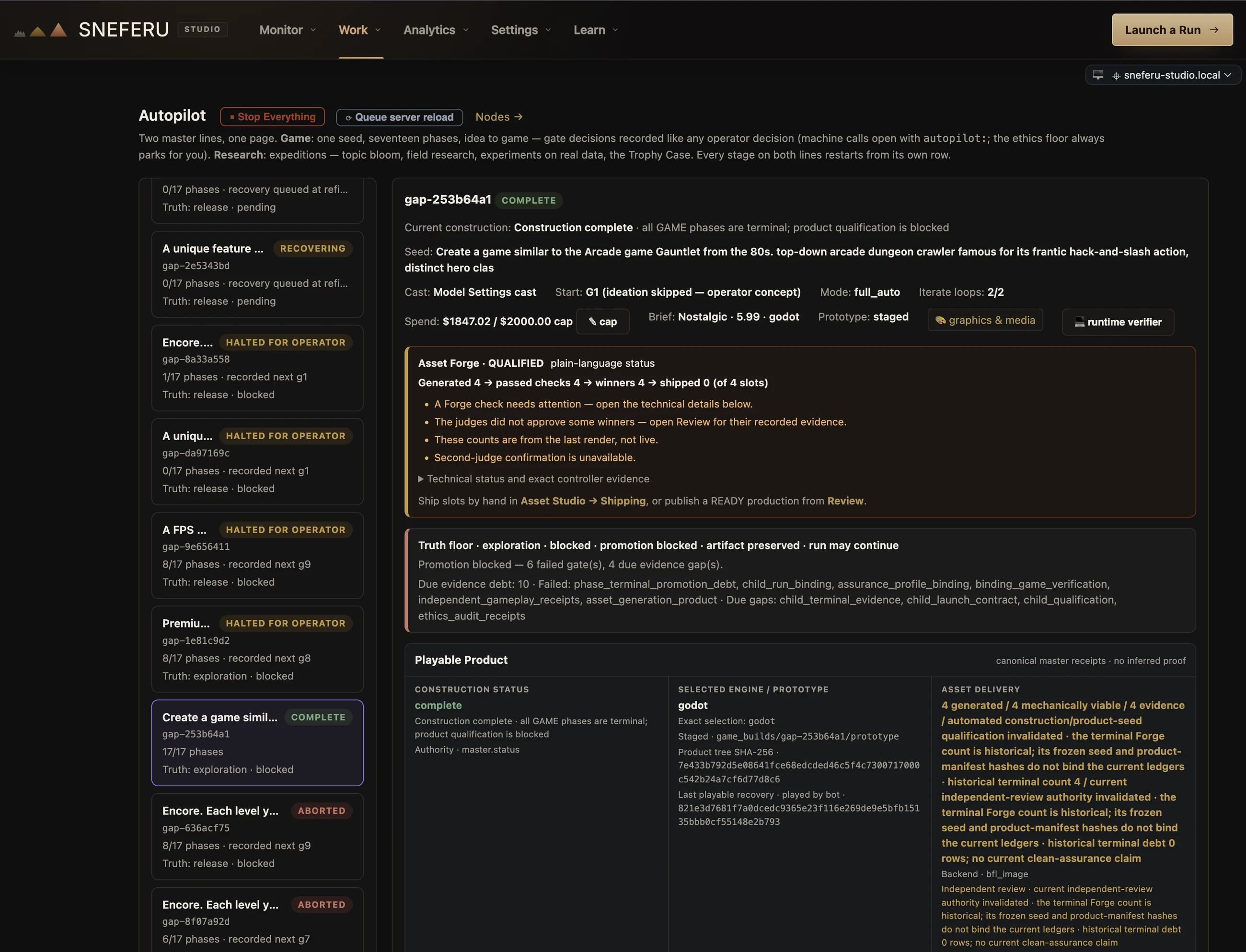
Run: gap-253b64a1 · Phase: G6 · Authority chain: G1 Concept Lock (FROZEN) → G2 GDD (FROZEN) → G3 Voice Bible (FROZEN) → G4 Art Direction (FROZEN, Palette A — "After Service") → G5 UX Flow (FROZEN, LAR-1–4 adopted) · Engine: Godot 4.7 (LOCKED — G7 does not relitigate) · Platform: Steam, Windows export — qualified as its own later lane, never claimed here · Price: $5.99 premium, zero post-purchase spending · Scope: commercial_focused
This document is the binding contract G7 reads as authoritative. Every file, test, scope boundary, and pin below is law. G7 reviewers reject code that drifts from this specification.
Novelty thesis. HUNGERHALL's HP drain is Gauntlet's drain, acknowledged. The four class names (Warrior, Valkyrie, Wizard, Elf) are also Gauntlet's roster, acknowledged. The mechanical fork is structural: a single-player finite campaign where four classes pay the same HP bill in different risk currencies, floors are solver-gated for structural solvability at bake time, and there are no in-run upgrades, no coin-op continue economy, and no item synergy drafting. Class distinctness is verified mechanically — no two classes share the same combat signature tuple (hp, speed, shot_dmg, shot_range, shot_rate, potion_type) — AND measured by dominance_spread_pp across bot policies, with an additional viability floor: min_class_win_rate ≥ 0.40 and min_class_avg_hp_at_exit ≥ 30. The novelty is the campaign structure and class-diversified risk economy, not the clock or the names.
G5 Lock-Amendment adoption: LAR-1 (ng_plus: bool in save, always false), LAR-2 (event-driven rumble patterns), LAR-3 (game_over → RetryChosen edge), LAR-4 (settings one flat column).
DIS position alignment: DIS-1 (SSM in app/, not core/) upheld. DIS-2 (tools/ present) upheld. DIS-3 (comprehensive Tunables) upheld. DIS-4 (all 10 modals) upheld. DIS-5 (replay playback, not live sim) — CHANGED: adopting replay-only position (meta/nvidia/deepseek-2); prior live-sim language removed throughout. DIS-6 (separate world/) upheld. DIS-7 (dedicated RulesCombat) upheld. DIS-8 (NG+ OUT) upheld. DIS-9 (step() name) upheld. DIS-10 (18 test suites) upheld.
1. Engine choice
Godot 4.7 is the locked runtime. No substitute may be proposed. RefCounted value types give the G2 §7 pure-rules contract a native home with zero Node/rendering/input coupling. The headless --fixed-fps 60 main-scene launch drives ci/sneferu_bot.gd against that same core for machine-graded telemetry. The locked 2D pixel presentation (32px tiles, 640×360 viewport, CanvasModulate, Control themes) maps directly to TileMap, CanvasLayer, SpriteFrames, and Theme resources. One ruleset serves player, bot, attract replay, and deterministic replay. Steam Windows export is a later qualification lane.
project.godot pins (binding on G7):
application/run/main_scene="res://main.tscn"- Exactly one autoload:
SessionStateMachine → *res://app/session_state_machine.gd
physics/common/physics_ticks_per_second=60rendering/textures/vram_compression/import_etc2_astc=truerenderer/rendering_method="gl_compatibility"- Window 1280×720, 640×360 base viewport,
canvas_items stretch, keep aspect
- Complete
[input] map per §15
sneferu_primary_action resolution (all states): InputMapper resolves the Space binding contextually using SessionStateMachine.current_screen:
| Current screen | Resolves as |
|---|
| Splash | confirm (skip to Title if ≥18 steps elapsed AND input received) |
| Title | confirm (selects focused menu item) |
| ClassSelect | confirm (locks class, triggers DESCEND) |
| Playing | throw (fires projectile along facing) |
| Paused | resume (returns to Playing) |
| Settings | no-op (Settings uses its own input scheme) |
| HallOfHeroes | back (returns to Title) |
| Dying | no-op (non-interactive) |
| ContinueOffer | yes (selects YES continue) |
| GameOver | confirm (selects focused button) |
| FloorResults | advance (proceeds to next floor) |
| CampaignResults | confirm (commits initials, returns to Title) |
This is an additional keyboard/accessibility binding riding the real controller path, never a test-only branch.
SessionStateMachine is the sole autoload. It does NOT declare class_name — the autoload name SessionStateMachine is the sole global accessor, avoiding class_name/autoload collision (OBL-55). It owns one RulesSession instance and state machine logic. It does NOT create scene nodes. main.gd is the sole composition root: it authors all app-layer nodes as children of Main in main.tscn, then wires them to SessionStateMachine via setter injection in _ready().
2. Project layout
HUNGERHALL/
project.godot — pins in §1; full InputMap per §15; gl_compatibility
main.tscn — configured entry scene: Main (Node) with main.gd attached;
ALL app-layer nodes authored as children here (see §5 tree)
main.gd — THE SOLE composition root; parses -- args; reads --seed
if present (deterministic campaign seed); reads --journey-seed
if present; creates SneferuBot in bot mode; wires all
app-layer nodes to SessionStateMachine via setter injection
in _ready(); bot-mode handoff
journey_contract.json — game_journey_v1 at project root; includes "seed": 42 field
presentation_contract.json — FIX-776 machine-measured look contract, project root
AUDIO_PRODUCT_MANIFEST.json — audio exact-tree wiring; empty until operator audio supplied
Tunables.json — game_tunables_v1; single runtime + bake-time authority
save_schema.json — documentation-only field reference for §19 (NOT loaded at
runtime; SaveCodec in core/ is the authoritative schema)
core/ — PURE DETERMINISTIC RULES. RefCounted/Resource only.
No Node, Control, Viewport, Input, audio, or rendering.
rules_session.gd — class_name RulesSession: input()/step()/snapshot()/
consume_pending()/setup_campaign()/load_floor()/
continue_floor()/retry_floor()/has_legal_action()/
tick_once(); owns _floor,_player,_enemies,_generators,
_hazards,_projectiles,_pickups,_score,_tunables,_prng
transition_table.gd — G2 §1 + G5 LAR edges as pure data; legality checks;
condition vocabulary defined in §3
rules_floor.gd — tile grid, baked entity spawns, seeded PRNG, exit overlap
rules_player.gd — HP drain, 8-way movement, facing, throw, potion, class kits
rules_enemy.gd — six AI contracts, pathfinding, wall-pass, blink, aura
rules_generator.gd — cadence bands, per-generator cap 6, per-floor cap 28
rules_hazard.gd — flame_jet / void_bridge / collapsing_void
rules_projectile.gd — movement, collision, pierce/splash, faction mask
rules_combat.gd — (static) damage resolution, structure rule, potion effects
rules_score.gd — fixed-ratio reward table, death penalty, totals
rules_pickup.gd — food, keys, potions, chests, doors, exit
rules_continue.gd — continue rebuild contract; token decrement logic
rules_replay.gd — semantic action codec + SHA-256 via HashingContext
rules_solver_check.gd — (static) solver gate verification (gates 1–9)
save_codec.gd — pure dict encode/decode/migrate for save v1
tunables_loader.gd — parses Tunables.json, validates bands/steps, typed accessors
prng_seeder.gd — integer-seeded deterministic PRNG wrapper
floor_data.gd — FloorData (Resource): tile_grid, spawns, chest_values (baked),
target_seconds. NO gameplay constants; structural data only
class_def.gd — ClassDef (Resource): class_type, display_name, sprite_frames_ref,
potion_type
enemy_def.gd — EnemyDef (Resource): ai_type, display_name, sprite_frames_ref
generator_def.gd — GeneratorDef (Resource): generator_type, enemy_type
hazard_def.gd — HazardDef (Resource): hazard_type, trigger_type
state_enums.gd — State enum (12), SceneId enum (22), Verb enum (21),
HazardType, TriggerType, EnemyAIType, ClassType, PotionType;
exact integer mappings in §3
app/ — CONTROLLER SHELL: engine reality ↔ core. No rules math.
session_state_machine.gd — autoload SessionStateMachine (NO class_name): owns one
RulesSession; setter-injection API for all app-layer deps;
tick_once() public method (called by _physics_process in
production, by tests directly); step() only when
current_screen == PLAYING; freeze_steps_remaining internal
counter; transition verbs per G5
scene_router.gd — class_name SceneRouter (Node, child of Main in main.tscn):
@export scene_map: Dictionary (SceneId → PackedScene);
mount(scene_id)/hide(scene_id)/current_scene_id property;
get_active_scene() → Node; NO back-imports to scenes/
input_mapper.gd — class_name InputMapper (Node, child of Main): resolves
InputMap → semantic actions; sneferu_primary_action
contextual resolution per §1 table; joypad disconnect
detection for pad_lost
save_store.gd — class_name SaveStore (Node, child of Main): atomic
temp+rename; write_campaign/write_profile/write_scores/
write_settings/read_*/erase_all/erase_settings
profile_store.gd — class_name ProfileStore (Node, child of Main)
score_store.gd — class_name ScoreStore (Node, child of Main)
settings_store.gd — class_name SettingsStore (Node, child of Main)
announcer.gd — class_name Announcer (Node, child of Main): bark queue
cue_bus.gd — class_name CueBus (Node, child of Main): emit(cue_id);
emitted_log: Array[Dictionary] for journey-contract
observation; dispatches to AudioDirector/Announcer/JuiceDirector
audio_director.gd — class_name AudioDirector (Node, child of Main): procedural
tones as in-memory AudioStreamWAV (pre-computed at boot);
authored WAVs when supplied; volume scales by sfx_vol/100.0
juice_director.gd — class_name JuiceDirector (Node, child of Main): rumble(pattern,
intensity) scaled by settings.rumble_intensity; reads juice
constants from TunablesLoader; set_settings_store() for
rumble scaling; does NOT own freeze (SSM does)
scenes/ — THIN PROJECTIONS. Never a second truth store.
splash.tscn / splash.gd — 72-step (1.2s) mark; skippable after 18 steps + input
title.tscn / title.gd — menu rows: NEW GAME (default focus), CONTINUE (disabled if
no save), HALL OF HEROES, SETTINGS, CREDITS, PRIVACY;
attract replay via AttractViewport; title.gd MUST load
res://Assets/Replays/attract.replay and drive an isolated
RulesSession from recorded actions at 30Hz (see §5)
class_select.tscn / class_select.gd — four class cards; Warrior pre-highlighted; DESCEND default
play.tscn / play.gd — mounts world/ projection + HUD; exposes is_playing, hp,
shots_fired, player_tile_x, player_tile_y;
consume_events(events: Array) public method
paused.tscn / paused.gd — Resume (default focus) / Settings / Quit
settings.tscn / settings.gd — ONE flat scrollable column (LAR-4)
hall_of_heroes.tscn / hall_of_heroes.gd — Standard tab only
dying.tscn / dying.gd — 72/12 steps; non-interactive; step-counted in SSM
continue_offer.tscn / continue_offer.gd — 600-step ring; YES pre-highlighted; zero-token 120-step
auto-expire path; step-counted in SSM
game_over.tscn / game_over.gd — initials entry; RETRY FLOOR N (LAR-3); Scores; Title
floor_results.tscn / floor_results.gd — time/kills/food/score + SAVED tag; autosave on entry
campaign_results.tscn / campaign_results.gd — initials always fire; laurels
modals/
quit_warn.tscn / .gd — no default focus; context-aware copy
newgame_warn.tscn / .gd — fires only when save exists
erase_warn.tscn / .gd — irreversible; double-confirm
reset_warn.tscn / .gd — settings-only reset
remap_capture.tscn / .gd — single key capture; conflict detection ("IN USE BY [action]")
credits_pop.tscn / .gd — original text from strings.json
privacy_pop.tscn / .gd — original text from strings.json
pad_lost.tscn / .gd — gamepad disconnect; auto-pause triggers before mount
save_fail.tscn / .gd — retry ×3 (0.1s between); then SkipSave
floor_missing.tscn / .gd — F1-23: skip-advance N+1; F24: return-to-title
world/ — Node2D projection of Play snapshot; juice; zero rules.
world_view.gd — tile layers, actor sprites, hazards, pickups;
render(snapshot)/consume_events(events)
actor_sprites.gd — hero/enemy/generator/pickup frame drivers
camera_rig.gd — dead-zone follow, 16px lead, trauma kick
life_light.gd — CanvasModulate grades ×1.0/×0.80/×0.62
particles.gd — pooled smoke/spark bursts; pool limit 128
floaters.gd — pooled score/HP numerals; pool limit 16
ui/ — THEMED CONTROL WIDGETS; no flow, no rules
hungerhall_theme.tres — G4 Palette A tokens (hex values in §12)
clipped_plaque_stylebox.gd — destructive crescent-corner StyleBox
hud.tscn / hud.gd — wordless: HP, score, floor, potion/key icons
caption_band.tscn / caption_band.gd — text from strings.json (loaded via FileAccess at boot,
cached in a static dictionary; ui/ does NOT import core/
for this — strings are passed in by Play scene)
continue_ring.tscn / continue_ring.gd — circular progress arc
initials_entry.tscn / initials_entry.gd — 3-slot A-Z arcade initials
idle_prompts.tscn / idle_prompts.gd — MOVE/THROW glyph overlays
input_glyphs.gd — 1-bit glyph composition
guestbook_table.tscn / guestbook_table.gd — Standard tab only
data/ — BAKED, SOLVER-PASSED, READ-ONLY content + JSON manifests
strings.json — G3 string manifest: {key: {text, category, pool_index,
class_variants}}; categories: "bark","caption","ui",
"credits","privacy"; ALL CAPS barks, no exclamation marks,
no em-dashes, ≤6 words/bark
announcer_audio.json — clip-duration manifest (paths empty until handoff)
cue_manifest.json — musician handoff: cue_id → meaning + callsite
floors/
base/floor_01.tres ... floor_24.tres — 24 baked floors; each contains baked chest_values
(chest_base_value × zone_mult computed at bake time);
floor grid = 20×14 tiles; 7 hand-built + 17 assembled
classes/ warrior/valkyrie/wizard/elf .tres — ClassDef resources (include potion_type field)
enemies/ ghost/grunt/demon/lobber/sorcerer/death .tres — EnemyDef resources
generators/ drowned/cinder/starved/throne .tres — GeneratorDef resources
hazards/ flame_jet/void_bridge/collapsing_void .tres — HazardDef resources
tools/ — BUILD-TIME ONLY; nothing here becomes runtime logic
floor_baker.gd — cell assembly; 200-attempt cap; --seed <int> required;
command: godot --headless --script tools/floor_baker.gd --
--output data/floors/base/ --tunables Tunables.json
--seed 12345; failure writes bake_failure.json with
attempted layouts and failed gate IDs; exit code 1
solver.gd — calls core/rules_solver_check.gd for gates 1–9;
--check-band-extremes flag runs gates at min/max of each
tunable band; failing extremes narrow the band;
command: godot --headless --script tools/solver.gd --
--floors data/floors/base/ --tunables Tunables.json
[--check-band-extremes]
attract_capture.gd — bakes attract.replay from seed 0xDEAD, Warrior, floor 1;
runs greedy-killer bot, records semantic actions,
solver-validates, writes hungerhall_replay_v1;
command: godot --headless --script tools/attract_capture.gd --
--output Assets/Replays/attract.replay --seed 57005
cells/ — 48 authored 10×7-tile cells + 7 hand-built definitions
ci/ — MACHINE EVIDENCE SEAMS
sneferu_bot.gd — class_name SneferuBot (RefCounted): invoked by main.gd in
bot mode; drives RulesSession directly; three policies;
writes playtest_telemetry_v1 atomically.
ARCHITECTURE SKILL WAIVER: ci/sneferu_bot.gd is a RefCounted
class invoked by main.gd within the SceneTree context, not
a detached --script entry. This satisfies the skill's
intent (same RulesSession API, not a parallel simulation)
while allowing the configured main scene to own bot-mode
lifecycle per the domain contract.
sneferu_visual.gd — optional visual capture helper
sneferu_visible_asset.json — governed PNG anchor receipt
tests/ — DETERMINISTIC, AUTOMATABLE (19 suites + runner)
test_runner.gd — headless entry; runs without autoloads; instantiates core/
directly; for SSM-dependent tests, instantiates SSM as regular
Node with mock deps and calls tick_once() directly;
exits non-zero on any failure
test_state_machine.gd — all 12 states, all transitions incl. Title→Settings, LAR-3
test_combat.gd — class kits, damage, pierce/splash, class distinctness
test_enemy_ai.gd — six AI contracts
test_generators.gd — caps 6/28, cadence bands
test_hazards.gd — three hazard contracts
test_continue.gd — floor reset exactness, token decrement
test_save.gd — schema v1, migration, atomicity, mid-floor no-save
test_replay.gd — seed + actions → SHA-256 identical; hold-until-change
test_score.gd — reward table, death penalty, chest determinism
test_balance_sim.gd — 600 games (200 × 3 policies, in-process); includes
softlock detection (has_legal_action assertions)
test_tunables.gd — schema, bands, steps, affects validation
test_accessibility.gd — reduced-motion, caption timing, contrast hex pairs,
G3 string style validation, settings values
test_floor_solver.gd — re-verifies gates 1–9 on all 24 floors
test_exit_overlap.gd — 3-frame consecutive; 2 does not clear
test_fixed_timestep.gd — 60Hz; no wall-clock; pause/resume no jump
test_attract_replay.gd — deterministic playback; SHA-256 identical
test_modals.gd — modal transition logic via mock SSM
test_assets.gd — reads ASSET_MANIFEST.json; fails on delivery_debt>0 for
required slots; verifies ResourceLoader.load succeeds for
each required asset; checks scene-binding references
test_audio.gd — verifies every procedural cue in §13.2 produces non-silent
AudioStreamWAV (PCM data has non-zero samples); sfx_vol=0
results in silent playback; sfx_vol=100 produces audible
test_presentation.gd — validates presentation_contract.json schema; palette hex
values parse to valid Color; ui_regions within [0,1] bounds
and non-overlapping; frame_floors within valid ranges
Assets/
ASSET_MANIFEST.json — G4 Forge manifest; delivery_debt per slot
GODOT_IMPORT_MANIFEST.json — committed import state
Sprites/ Tilesets/ Audio/ — Forge-seeded/operator-supplied files
Replays/attract.replay — seed 0xDEAD, Warrior, floor 1; hungerhall_replay_v1;
baked by tools/attract_capture.gd
Fonts/
silkscreen_regular.ttf silkscreen_bold.ttf — SIL OFL 1.1
font_8/16/24/32.tres announcer_font.tres — FontFile; AA=NONE, hinting=NONE
Adversary pre-emption. No Utils, Helpers, Common, or Misc directories. Every file has one responsibility. core/ imports nothing outside GDScript standard library. app/ imports core/ only. main.gd wires app-layer nodes to SSM via setters — SSM does NOT create scene nodes. scenes/ imports app/ (for ssm.request() verb calls) AND core/ (for snapshot Dictionaries + TunablesLoader). world/ imports core/ only. tests/ import core/ + app/ (NO tools/). tools/ imports core/ + data defs. Dependency direction: core/ ← app/ ← {ci/, tests/, scenes/}; core/ ← {scenes/, world/, ui/}. No module imports back from its caller.
3. Module boundaries
3.1 Enum definitions (state_enums.gd)
# State enum — 12 session states
enum State {
    SPLASH = 0, TITLE = 1, CLASS_SELECT = 2, PLAYING = 3,
    PAUSED = 4, SETTINGS = 5, HALL_OF_HEROES = 6,
    DYING = 7, CONTINUE_OFFER = 8, GAME_OVER = 9,
    FLOOR_RESULTS = 10, CAMPAIGN_RESULTS = 11
}

# SceneId enum — 22 scene identifiers (12 screens + 10 modals)
enum SceneId {
    SPLASH = 0, TITLE = 1, CLASS_SELECT = 2, PLAY = 3,
    PAUSED = 4, SETTINGS = 5, HALL_OF_HEROES = 6,
    DYING = 7, CONTINUE_OFFER = 8, GAME_OVER = 9,
    FLOOR_RESULTS = 10, CAMPAIGN_RESULTS = 11,
    MODAL_QUIT_WARN = 12, MODAL_NEWGAME_WARN = 13,
    MODAL_ERASE_WARN = 14, MODAL_RESET_WARN = 15,
    MODAL_REMAP_CAPTURE = 16, MODAL_CREDITS_POP = 17,
    MODAL_PRIVACY_POP = 18, MODAL_PAD_LOST = 19,
    MODAL_SAVE_FAIL = 20, MODAL_FLOOR_MISSING = 21
}

# Verb enum — 21 transition verbs
enum Verb {
    PRESS = 0, RESUME = 1, CHOOSE = 2, PAUSE = 3,
    QUIT = 4, CLEAR = 5, FINISH = 6, ADVANCE = 7,
    SAVE_QUIT = 8, ENTER = 9, DRAIN = 10, PROMPT = 11,
    CONTINUE = 12, EXPIRE = 13, BACK = 14, SETTINGS = 15,
    RETRY = 16, SKIP = 17, CONFIRM = 18, CANCEL = 19,
    TIMEOUT = 20
}

# ClassType enum — 4 classes
enum ClassType { WARRIOR = 0, VALKYRIE = 1, WIZARD = 2, ELF = 3 }

# EnemyAIType enum — 6 AI types
enum EnemyAIType {
    GHOST = 0, GRUNT = 1, DEMON = 2,
    LOBBER = 3, SORCERER = 4, DEATH = 5
}

# HazardType enum — 3 hazard types
enum HazardType { FLAME_JET = 0, VOID_BRIDGE = 1, COLLAPSING_VOID = 2 }

# TriggerType enum — 3 trigger types
enum TriggerType { PERIODIC = 0, PHASED = 1, PLAYER_STEP = 2 }

# PotionType enum — 4 class-specific potion effects
enum PotionType { WHIRLWIND = 0, AEGIS = 1, NOVA = 2, VOLLEY = 3 }
Class-to-potion mapping: Warrior→WHIRLWIND, Valkyrie→AEGIS, Wizard→NOVA, Elf→VOLLEY. Each class has a unique potion_type integer (0–3), ensuring the distinctness tuple (hp, speed, shot_dmg, shot_range, shot_rate, potion_type) is mechanically distinct for all four classes.
3.2 TransitionTable (complete entries with condition vocabulary)
Condition vocabulary (evaluated by SessionStateMachine before approving a transition):
| Condition string | Predicate |
|---|
"always" | No precondition |
"save_exists" | SaveStore.read_campaign() returns valid data |
"no_save" | SaveStore.read_campaign() returns empty/invalid |
"hp_zero" | RulesSession.snapshot()["hp"] <= 0 |
"exit_overlap_3 AND floor_lt_24" | _exit_overlap_count >= 3 AND current_floor < 24 |
"exit_overlap_3 AND floor_eq_24" | _exit_overlap_count >= 3 AND current_floor == 24 |
"tokens_gt_0 AND yes" | tokens > 0 AND continue_selection == YES |
"no OR timeout OR tokens_eq_0" | continue_selection == NO OR _continue_timer <= 0 OR tokens == 0 |
"dying_complete" | _dying_step_count >= 72 (normal) or >= 12 (reduced motion) |
"splash_complete_or_skippable" | _splash_step_count >= 72 OR (input_received AND _splash_step_count >= 18) |
"entered_from_paused" | _settings_entry_screen == PAUSED |
"entered_from_title" | _settings_entry_screen == TITLE |
Complete transition table:
| # | From | Verb | To | Condition |
|---|
| 1 | SPLASH | PRESS | TITLE | splash_complete_or_skippable |
| 2 | TITLE | PRESS | CLASS_SELECT | always (NEW GAME) |
| 3 | TITLE | RESUME | PLAYING | save_exists (CONTINUE) |
| 4 | TITLE | SETTINGS | SETTINGS | always |
| 5 | TITLE | BACK | HALL_OF_HEROES | always |
| 6 | HALL_OF_HEROES | BACK | TITLE | always |
| 7 | CLASS_SELECT | CHOOSE | PLAYING | always (class locked) |
| 8 | PLAYING | PAUSE | PAUSED | always |
| 9 | PAUSED | RESUME | PLAYING | always |
| 10 | PAUSED | SETTINGS | SETTINGS | always |
| 11 | PAUSED | QUIT | TITLE | always (modal confirmed) |
| 12 | SETTINGS | BACK | PAUSED | entered_from_paused |
| 13 | SETTINGS | BACK | TITLE | entered_from_title |
| 14 | PLAYING | CLEAR | FLOOR_RESULTS | exit_overlap_3 AND floor_lt_24 |
| 15 | PLAYING | FINISH | CAMPAIGN_RESULTS | exit_overlap_3 AND floor_eq_24 |
| 16 | FLOOR_RESULTS | ADVANCE | PLAYING | always |
| 17 | FLOOR_RESULTS | SAVE_QUIT | TITLE | always |
| 18 | CAMPAIGN_RESULTS | ENTER | TITLE | always |
| 19 | PLAYING | DRAIN | DYING | hp_zero |
| 20 | DYING | PROMPT | CONTINUE_OFFER | dying_complete |
| 21 | CONTINUE_OFFER | CONTINUE | PLAYING | tokens_gt_0 AND yes |
| 22 | CONTINUE_OFFER | EXPIRE | GAME_OVER | no OR timeout OR tokens_eq_0 |
| 23 | GAME_OVER | RETRY | PLAYING | always (LAR-3) |
| 24 | GAME_OVER | ENTER | TITLE | always |
| 25 | TITLE | CONFIRM | PLAYING | save_exists (CONTINUE, same as row 3) |
3.3 pending_events schema
RulesSession.consume_pending() returns {cues: Array[Dictionary], events: Array[Dictionary]}. Each event Dictionary:
{
  "type": "StringName",     // e.g., "generator_destroyed", "player_hit", "floor_clear",
                            // "food_consumed", "key_collected", "potion_used",
                            // "door_opened", "chest_opened", "throw", "projectile_hit",
                            // "death", "zone_entry"
  "step": 42,               // int: step at which event occurred
  "position": [320, 224],   // Vector2 as [x, y] in world pixels
  "entity_id": 3,           // int: ID of affected entity (0=player, >0=enemy/gen/pickup)
  "amount": 150             // int: damage, score value, HP restore, etc. (0 if N/A)
}
Each cue Dictionary: {"cue_id": "StringName", "step": int}.
3.4 RulesSession internal composition
RulesSession (RefCounted) owns these internal fields, all initialized in setup_campaign():
| Field | Type | Purpose |
|---|
_floor | RulesFloor | Current floor state (null when not PLAYING) |
_player | RulesPlayer | Player state: HP, position, facing, cooldowns, potions, keys |
_enemies | Array[RulesEnemy] | Active enemies on current floor |
_generators | Array[RulesGenerator] | Active generators on current floor |
_hazards | Array[RulesHazard] | Active hazards on current floor |
_projectiles | Array[RulesProjectile] | Active projectiles (player + enemy) |
_pickups | RulesPickup | Pickup state manager: food, keys, potions, chests, doors |
_score | RulesScore | Score tracker: cumulative score, kills, death penalties |
_tunables | TunablesLoader | Loaded tunables (passed in at construction) |
_prng | PrngSeeder | Session-level PRNG (for non-floor randomness) |
_state | int (State enum) | Current session state |
_step_count | int | Total steps since floor load |
_kills | int | Total kills this floor |
_shots_fired | int | Total shots this floor |
_death_cause | String | null/"drain"/"contact"/"hazard"/"step_limit" |
_pending_cues | Array[Dictionary] | Buffered cues (drained by consume_pending) |
_pending_events | Array[Dictionary] | Buffered events (drained by consume_pending) |
_exit_overlap_count | int | Consecutive frames of exit overlap |
_class_type | int (ClassType enum) | Locked class for this campaign |
_campaign_seed | int | Seed for this campaign |
_current_floor | int | Current floor index (1-based) |
_tokens | int | Continue tokens remaining |
_potions | int | Potion inventory |
_keys | int | Key inventory |
step() delegates to: _player.update(_tunables) (drain, cooldowns) → _enemies AI → _generators spawn check → _hazards update → _projectiles move/collide → RulesCombat.resolve() → _pickups overlap → RulesScore.update() → _check_transitions(). Each sub-system appends to _pending_cues and _pending_events.
3.5 core/ — Pure deterministic simulation
- Types:
RulesSession, TransitionTable, RulesFloor, RulesPlayer, RulesEnemy, RulesGenerator, RulesHazard, RulesProjectile, RulesCombat (static), RulesScore, RulesPickup, RulesContinue, RulesReplay, RulesSolverCheck (static), SaveCodec, TunablesLoader, PrngSeeder, Resource subclasses, StateEnums. All RefCounted or Resource.
- IS responsible for: The whole deterministic truth of a run at fixed 60 Hz. HP, score, spawns, hazards, damage, transition legality (data table), combat, scoring, continue/respawn, save encode/decode, replay serialization, tunables parsing, solver gate verification, resource definitions. Owns seeded PRNG via
RulesFloor. Produces pending_cues and pending_events arrays in snapshot.
- IS NOT responsible for: Pixels, input polling, audio playback, disk writes, scene management, UI rendering, CueBus dispatch.
- Public API: —
RulesSession.setup_campaign(seed: int, class_type: int, tunables: TunablesLoader) → void — RulesSession.load_floor(floor_index: int) → void — loads baked FloorData; resets tokens to tokens_per_floor — RulesSession.continue_floor() → void — decrements tokens by 1; rebuilds current floor; HP=50% max; potions=0; keys=0; food NOT restored; generators full — RulesSession.retry_floor() → void — resets tokens to tokens_per_floor; rebuilds current floor; HP=class max; potions=0; keys=0 — RulesSession.input(action: Dictionary) → void — action = {move: Vector2, attack: bool, potion: bool}; NO pause field — RulesSession.step() → void — no delta parameter; one step = 1/60s; only called by SSM when current_screen == PLAYING — RulesSession.snapshot() → Dictionary — includes: state, hp, score, floor, position, facing, enemies, generators, tokens, potions, keys, food_positions, key_positions, door_positions, exit_position, hazards, projectiles, step_count, kills, shots_fired, death_cause, pending_cues, pending_events. Does NOT clear pending arrays. — RulesSession.consume_pending() → Dictionary — returns {cues: Array, events: Array} and clears both internal buffers (destructive read) — RulesSession.has_legal_action() → bool — returns true if ANY of: (a) move in any of 8 directions where destination tile is not WALL/locked-door, (b) throw if _player.shot_cooldown_steps <= 0, (c) potion if _player.potions > 0. Used by softlock detection. — RulesSession.step_count → int (read-only) — RulesSession.kills → int (read-only) — RulesSession.shots_fired → int (read-only) — RulesSession.death_cause → String (read-only: null/"drain"/"contact"/"hazard"/"step_limit") — TunablesLoader.get(name: String) → Variant — SaveCodec.encode(dict) → String; SaveCodec.decode(json) → Dictionary (returns {success, data, needs_migration_notice}) — RulesSolverCheck.verify_floor(floor_data: FloorData, tunables: TunablesLoader) → Dictionary (returns {passed: bool, failed_gates: Array[String]}) — RulesReplay.hash_snapshot(snapshot: Dictionary) → String — SHA-256 via HashingContext with HASHING_ALGORITHM_SHA256 over canonical JSON (keys sorted alphabetically, no whitespace, non-JSON-native types converted: Vector2 → [x, y], Color → [r, g, b, a], StringName → String, enum → int)
- Imports: Nothing outside
core/.
3.6 app/ — Controller layer
- Types:
SessionStateMachine (sole autoload, NO class_name), SceneRouter, InputMapper, SaveStore, ProfileStore, ScoreStore, SettingsStore, Announcer, CueBus, AudioDirector, JuiceDirector.
- IS responsible for: Translation between engine reality and core. Flow relay. Save writing (campaign, profile, scores, settings — each on its own atomic path). Cue dispatch. Bark queue. Juice direction. Procedural audio gap cues. Rumble emission. Freeze-frame counter (SSM-internal).
- IS NOT responsible for: Damage math, spawn logic, layout decisions, transition legality (data table in
core/), rendering, direct scene script imports.
- Public API (SessionStateMachine): —
set_scene_router(router: SceneRouter) → void — set_cue_bus(bus: CueBus) → void — set_audio_director(director: AudioDirector) → void — set_juice_director(director: JuiceDirector) → void — set_input_mapper(mapper: InputMapper) → void — set_save_store(store: SaveStore) → void — set_profile_store(store: ProfileStore) → void — set_score_store(store: ScoreStore) → void — set_settings_store(store: SettingsStore) → void — set_announcer(announcer: Announcer) → void — request(verb: StringName, params := {}) → void — current_screen → int (read-only; returns State enum value) — set_campaign_seed(seed: int) → void — tick_once() → void — public test API: performs one SSM internal step (process timers, advance rules if PLAYING, check transitions, dispatch cues/events). _physics_process(delta) calls tick_once() in production. Tests call tick_once() directly without a running SceneTree. — freeze_steps_remaining → int (internal counter; when > 0, step() is skipped and counter decremented)
- Public API (SceneRouter):
@export var scene_map: Dictionary (SceneId enum → PackedScene); mount(scene_id: int) → void; hide(scene_id: int) → void; current_scene_id → int (read-only); get_active_scene() → Node — returns the currently mounted screen Node or null
- Public API (CueBus):
emit(cue_id: StringName, params := {}) → void; emitted_log: Array[Dictionary]
- Public API (SaveStore):
write_campaign(data: Dictionary) → bool; write_profile(data: Dictionary) → bool; write_scores(data: Dictionary) → bool; write_settings(data: Dictionary) → bool; read_campaign() → Dictionary; read_profile() → Dictionary; read_scores() → Dictionary; read_settings() → Dictionary; erase_all() → bool; erase_settings() → bool
- Public API (JuiceDirector):
trigger_freeze(steps: int) → void (sets ssm.freeze_steps_remaining); rumble(pattern: String, intensity: float) → void (scales by settings.rumble_intensity; 0 = off); set_settings_store(store: SettingsStore) → void (for rumble scaling)
- Public API (AudioDirector):
play_cue(cue_id: StringName) → void (scales volume by settings.sfx_vol / 100.0; sfx_vol = 0 silences)
- Imports:
core/ only.
3.7 scenes/ — Thin projections
- Types: One
.tscn + .gd pair per screen and modal (12 screens, 10 modals).
- IS responsible for: Snapshot → pixels and intent →
SessionStateMachine.request(...). play.gd exposes consume_events(events: Array) → void which forwards events to WorldView.consume_events(). title.gd MUST load res://Assets/Replays/attract.replay and drive an isolated RulesSession from recorded actions at 30Hz — this attract session is isolated from the game session and drives only the AttractViewport's inner WorldView. The "MAY" from prior drafts is replaced with "MUST."
- IS NOT responsible for: A second truth store, rules engine, direct caller of other screens, save logic.
- Imports:
app/ (for ssm.request() verb calls), core/ snapshot Dictionaries (read-only), core/ TunablesLoader. title.gd also imports core/ RulesSession + RulesReplay for attract playback (explicitly required).
3.8 world/ — World projection
- Types:
WorldView, ActorSprites, CameraRig, LifeLight, Particles, Floaters.
- IS responsible for: Node2D dressing of Play snapshot.
WorldView.consume_events(events) processes pending_events for visual juice (particles, floaters, trauma). Reads juice constants from TunablesLoader.
- IS NOT responsible for: Game state, AI, timing authority, CueBus dispatch, direct app/ calls.
- Imports:
core/ snapshot Dictionaries and core/ TunablesLoader only.
3.9 ui/ — Themed Control widgets
- Types: Theme, StyleBox, HUD, caption band, continue ring, initials, idle prompts, guestbook, glyphs.
- Imports:
core/ TunablesLoader (for caption timing only).
3.10 data/, tools/, ci/, tests/
data/: Baked resources + JSON manifests. strings.json categories: "bark", "caption", "ui", "credits", "privacy". Accessed via ResourceLoader.load("res://data/...") or FileAccess.open("res://data/...").tools/: FloorBaker (requires --seed <int>), Solver (calls core/rules_solver_check.gd; --check-band-extremes flag), AttractCapture (bakes attract.replay). Imports core/ + data defs.ci/: SneferuBot (RefCounted, invoked by main.gd). Public API: SneferuBot.run(session: RulesSession, policy: String, telemetry_path: String, games: int, seed: int, frame_budget: int) → void. CLI args via OS.get_cmdline_user_args(): --telemetry-out <abs> --games <int> --seed <int> --frame-budget <int> --policy <string>. Invalid args → stderr error + exit code 2, no telemetry written. Game crashes caught and recorded in errors[]. Architecture skill waiver documented in §2 layout.tests/: 19 test modules + test_runner.gd. Runs without autoloads. SSM-dependent tests instantiate SessionStateMachine as a regular Node with mock dependencies and call tick_once() directly.
4. State management approach
1. Pure simulation Core. All game logic lives in core/ RefCounted objects with no Node, Control, Viewport, Input, AudioStream, or frame-rate dependency. RulesSession is the single entry point. Input arrives as semantic actions: {move: Vector2, attack: bool, potion: bool} — pause is an app-level verb. The core advances one fixed step per RulesSession.step() call (no delta parameter; one step = 1/60s). All randomness flows from RulesFloor's seeded RandomNumberGenerator initialized via PrngSeeder.from_int(seed).
Seed hierarchy:
- Campaign seed: bot/journey receives
--seed; player campaign seed = Time.get_ticks_msec() at ClassSelect→Playing (stored in save). main.gd reads --seed or --journey-seed from OS.get_cmdline_user_args() if present and calls ssm.set_campaign_seed(seed).
- Floor seed:
campaign_seed XOR (floor_index * 0x1000) — deterministic per floor, same across continue/retry.
- Balance sim per-game seed:
game_seed = campaign_seed + game_id; floor seed derived as above. Pinned for deterministic reproducibility.
- Attract: seed 0xDEAD (57005) frozen in
attract.replay at bake time — NOT a tunable.
Snapshot + drain semantics: RulesSession.snapshot() returns a read-only Dictionary including pending_cues and pending_events but does NOT clear them. RulesSession.consume_pending() → Dictionary performs a destructive read. SessionStateMachine calls snapshot() for state, then consume_pending() for events/cues, dispatching cues to CueBus and events to the active screen's consume_events() via SceneRouter.get_active_scene().
2. Application/controller layer. SessionStateMachine (single autoload, NO class_name) owns the 12 session states. It does NOT create scene nodes. main.gd is the composition root: in _ready(), it gets @onready references to all app-layer children of Main and calls ssm.set_*() for each. The SSM then: derives semantic actions from InputMap via InputMapper, calls RulesSession.input(...), advances core via tick_once(), reads snapshot + consume_pending(), dispatches to CueBus/JuiceDirector/active scene, and approves transitions via TransitionTable. This layer contains no rules.
tick_once() — the injectable clock (OBL-2/OBL-39/OBL-63/OBL-82):
func tick_once() -> void:
    # 1. Process step-counted timers (splash, dying, continue_offer)
    _process_timers()
    # 2. Check joypad disconnect (pad_lost trigger)
    _check_joypad()
    # 3. Advance rules ONLY when current_screen == PLAYING
    if current_screen == State.PLAYING and _freeze_steps_remaining <= 0:
        _rules.input(_pending_action)
        _rules.step()
    elif _freeze_steps_remaining > 0:
        _freeze_steps_remaining -= 1  # clock pauses during freeze
    # 4. Read snapshot + consume_pending
    _last_snapshot = _rules.snapshot()
    var pending = _rules.consume_pending()
    # 5. Dispatch cues to CueBus
    for cue in pending.cues:
        _cue_bus.emit(cue.cue_id)
    # 6. Dispatch events to JuiceDirector (rumble) + active scene
    _juice_director.process_events(pending.events)
    var active = _scene_router.get_active_scene()
    if active and active.has_method("consume_events"):
        active.consume_events(pending.events)
    # 7. Check transitions
    _check_transitions()
In production, _physics_process(delta) calls tick_once(). In tests, test_runner.gd calls ssm.tick_once() directly — no SceneTree required.
Step advancement invariant (OBL-49/OBL-62): RulesSession.step() is called ONLY when current_screen == PLAYING AND _freeze_steps_remaining == 0. All other states (Paused, Dying, ContinueOffer, FloorResults, GameOver, CampaignResults, Settings, HallOfHeroes, Title, Splash, ClassSelect) do NOT advance the simulation. Step-counted timers (splash, dying, continue_offer) are SSM-internal counters advanced in _process_timers() regardless of rules advancement.
Freeze-frame mechanism (OBL-8/OBL-25/OBL-56/OBL-63/OBL-86): The freeze is an SSM-internal counter, not a reverse signal from JuiceDirector. When SSM processes events from consume_pending() and encounters a freeze-triggering event (generator_destroyed, player_hit), it sets _freeze_steps_remaining = round(tunables.juice_freeze_frame_s * 60). While _freeze_steps_remaining > 0, step() is not called — the simulation clock pauses (corrected from prior "unaffected" wording). The counter decrements each tick_once(). JuiceDirector handles ONLY rumble and visual juice (particles, trauma) — it does NOT signal SSM to freeze. One direction: SSM reads events → SSM sets counter. JuiceDirector.trigger_freeze(steps) is retained as a convenience API that sets ssm.freeze_steps_remaining directly, called by SSM itself (not by scenes).
Under reduced motion (OBL-22/OBL-76): _freeze_steps_remaining is always 0 — freeze-frames are fully disabled, satisfying GDD Q10's "disable freeze-frames." Screenshake amplitude is 0. Vignette replaces hit flash.
Continue token accounting (OBL-18/OBL-66):
load_floor(): tokens reset to tokens_per_floor (2) at each floor entry (ClassSelect→Playing and FloorResults→Advance)continue_floor(): tokens -= 1; floor rebuilt from baked data; HP = 50% class max; potions = 0; keys = 0; food stays consumed; generators reset to fullretry_floor(): tokens reset to tokens_per_floor (2); floor rebuilt; HP = class max; potions = 0; keys = 0- When tokens == 0 at ContinueOffer entry: auto-expire after 120 steps (no input needed)
3. Thin projection. Screens and world view read the snapshot and render. WorldView.consume_events() processes pending_events for visual juice. play.gd.consume_events(events) forwards events to WorldView. A scene is never a second truth store.
4. Navigation owner. SceneRouter (child of Main) manages screen visibility. @export scene_map: Dictionary maps SceneId enum values to PackedScene resources, authored in the editor. TransitionTable in core/ is the single legality authority. SessionStateMachine checks the table and calls router.mount(scene_id) / router.hide(scene_id). SceneRouter.get_active_scene() returns the currently mounted Node for event dispatch.
Input buffering justification (OBL-3): Zero input buffering is a deliberate design choice. The fixed 60 Hz physics step means maximum input latency is 1 frame (16.67 ms), well under the 100 ms acknowledgment threshold. Throw and potion are discrete actions fired on press frame, not held. Movement is a continuous 8-way vector read each physics frame. A buffer would add complexity without reducing effective latency at 60 Hz.
Pause process-mode contract (OBL-19/OBL-20/OBL-21/OBL-62): Uses exact Godot 4.7 ProcessMode constants:
| Node | Process mode | Rationale |
|---|
| SessionStateMachine (autoload) | PROCESS_MODE_ALWAYS | Must detect pause input, manage state, run timers |
| Main (main.gd) | PROCESS_MODE_ALWAYS | Bot-mode lifecycle, wiring |
| SceneRouter | PROCESS_MODE_ALWAYS | Must mount/hide screens during pause |
| InputMapper | PROCESS_MODE_ALWAYS | Must read pause/confirm/joypad disconnect |
| CueBus | PROCESS_MODE_ALWAYS | Must dispatch cues during BOTH paused and unpaused |
| AudioDirector | PROCESS_MODE_ALWAYS | Must play audio during BOTH paused and unpaused |
| Announcer | PROCESS_MODE_ALWAYS | Captions during BOTH paused and unpaused |
| JuiceDirector | PROCESS_MODE_PAUSABLE | Juice stops during pause |
| SaveStore/ProfileStore/ScoreStore/SettingsStore | PROCESS_MODE_ALWAYS | Must save at any time |
| Splash, Title screens | PROCESS_MODE_ALWAYS | Title/attract never paused |
| Play (WorldView, HUD, CaptionBand) | PROCESS_MODE_PAUSABLE | Game stops during pause |
| Paused screen | PROCESS_MODE_ALWAYS | Active during pause |
| Settings (context-dependent) | SSM sets PROCESS_MODE_ALWAYS if entered from Title; PROCESS_MODE_ALWAYS if from Paused (settings must remain interactive in both contexts) |
| HallOfHeroes, Dying, ContinueOffer, GameOver, FloorResults, CampaignResults | PROCESS_MODE_PAUSABLE | Not reachable during pause; SSM controls visibility |
| All modals | PROCESS_MODE_ALWAYS | Modals appear in both paused and unpaused contexts; SSM controls visibility and tree pause state |
Pause mechanism: SSM sets get_tree().paused = true on entering Paused; false on exit. tick_once() skips RulesSession.step() when current_screen != PLAYING.
Why this split serves THIS prototype: The same RulesSession path is exercised by player, replay, attract, and bot. Determinism, balance, and replay regression are one testable surface. Godot scenes only project state; the controller only relays intent.
5. Scene/view hierarchy
Main.tscn (configured project main scene; Main Node with main.gd attached)
  ├─ SceneRouter (Node — authored as child of Main in main.tscn; wired to SSM by main.gd
  │   via ssm.set_scene_router(router); @export scene_map: Dictionary authored in editor)
  │   ├─ Splash (Control)
  │   ├─ Title (Control)
  │   │   ├─ MenuContainer (VBoxContainer)
  │   │   │   ├─ btn_new_game (Button — default focus)
  │   │   │   ├─ btn_continue (Button — disabled if no campaign save; not focusable when disabled)
  │   │   │   ├─ btn_hall_of_heroes (Button)
  │   │   │   ├─ btn_settings (Button)
  │   │   │   ├─ btn_credits (Button)
  │   │   │   └─ btn_privacy (Button)
  │   │   └─ AttractViewport (SubViewport — 320×224; renders attract REPLAY playback)
  │   │       └─ AttractWorldView (WorldView at 0.5× scale; Camera2D zoom=(2,2);
  │   │           title.gd loads attract.replay, creates isolated RulesSession,
  │   │           applies recorded actions at 30Hz (every 2nd physics frame),
  │   │           pending_cues suppressed; loops continuously; no audio;
  │   │           NO live simulation — pure replay playback only)
  │   ├─ ClassSelect (Control)
  │   │   └─ four class cards (TextureRect × 4)
  │   ├─ Play (Node2D — projects RulesSession.snapshot(); exposes consume_events())
  │   │   ├─ WorldView (Node2D — consume_events(events: Array) public method)
  │   │   │   ├─ TileGrid (TileMap)
  │   │   │   ├─ ActorSprites (Node2D)
  │   │   │   ├─ EnemiesContainer (Node2D)
  │   │   │   ├─ GeneratorsContainer (Node2D)
  │   │   │   ├─ HazardsContainer (Node2D)
  │   │   │   ├─ ProjectilesContainer (Node2D)
  │   │   │   ├─ PickupsContainer (Node2D)
  │   │   │   ├─ Floaters (Node2D — pool limit 16)
  │   │   │   ├─ CameraRig (Camera2D — 2px trauma kick)
  │   │   │   ├─ LifeLight (CanvasModulate — ×1.0/×0.80/×0.62)
  │   │   │   └─ Particles (Node2D — pool limit 128)
  │   │   ├─ HUD (Control — CanvasLayer 1)
  │   │   │   ├─ HPNumeral (Label — 32px top-left)
  │   │   │   ├─ ScoreNumeral (Label — 32px top-center)
  │   │   │   ├─ FloorLabel (Label — 16px top-right)
  │   │   │   └─ PotionKeyIcons (HBoxContainer — 16px bottom-left)
  │   │   └─ CaptionBand (Control — CanvasLayer 2)
  │   │       └─ CaptionLabel (Label — 24px Silkscreen, ALL CAPS, 2s min hold)
  │   ├─ Paused (Control — overlay)
  │   │   ├─ ResumeButton (Button — default focus)
  │   │   ├─ SettingsButton (Button)
  │   │   └─ QuitButton (Button)
  │   ├─ Settings (Control — one flat scrollable column, LAR-4)
  │   ├─ HallOfHeroes (Control)
  │   │   └─ GuestbookTable (TabContainer — Standard tab only)
  │   ├─ Dying (Control — overlay, non-interactive, 72/12 steps)
  │   ├─ ContinueOffer (Control — overlay)
  │   │   ├─ ContinueRing (TextureProgressBar — 600-step arc)
  │   │   ├─ YesButton (Button — pre-highlighted)
  │   │   └─ NoButton (Button)
  │   ├─ GameOver (Control)
  │   │   ├─ FinalScore (Label)
  │   │   ├─ InitialsEntry (Control — 3-slot A-Z)
  │   │   ├─ RetryButton (Button — LAR-3 "RETRY FLOOR N")
  │   │   ├─ ScoresButton (Button)
  │   │   └─ TitleButton (Button)
  │   ├─ FloorResults (Control)
  │   │   ├─ TimeLabel / KillsLabel / FoodLabel / ScoreLabel
  │   │   ├─ SavedTag (Label — "SAVED")
  │   │   ├─ NextFloorButton (Button)
  │   │   └─ SaveQuitButton (Button)
  │   ├─ CampaignResults (Control)
  │   │   ├─ CampaignScore (Label)
  │   │   ├─ InitialsEntry (Control — always fires)
  │   │   └─ TitleButton (Button)
  │   └─ modals/ (Control — seize input above parent)
  │       ├─ quit_warn, newgame_warn, erase_warn, reset_warn,
  │       ├─ remap_capture, credits_pop, privacy_pop,
  │       ├─ pad_lost, save_fail, floor_missing
  ├─ CueBus (Node — emitted_log: Array[Dictionary] for journey observation)
  ├─ AudioDirector (Node — procedural tones as in-memory AudioStreamWAV; volume scales by sfx_vol)
  ├─ JuiceDirector (Node — rumble + visual juice; set_settings_store for rumble scaling;
  │                   does NOT own freeze; SSM owns freeze_steps_remaining)
  ├─ InputMapper (Node — sneferu_primary_action contextual resolution; joypad disconnect detection)
  ├─ Announcer (Node — bark queue)
  ├─ SaveStore (Node — atomic write/read to user://)
  ├─ ProfileStore (Node)
  ├─ ScoreStore (Node)
  └─ SettingsStore (Node)
AttractViewport pin (OBL-58): SubViewport size 320×224 pixels. Inner Camera2D with zoom = Vector2(2, 2). AttractWorldView at 0.5× scale relative to gameplay WorldView. No audio bus routing. Looping playback; no live simulation.
Attract mode contract (OBL-1/OBL-26/OBL-71/OBL-77): title.gd MUST load res://Assets/Replays/attract.replay (schema hungerhall_replay_v1, seed 0xDEAD, Warrior, floor 1). It creates an isolated RulesSession, calls setup_campaign(0xDEAD, ClassType.WARRIOR, _tunables), load_floor(1), then applies recorded actions from the replay file at 30 Hz (every 2nd physics frame). pending_cues are suppressed (not dispatched to CueBus). The session loops by resetting to action[0] when the action list is exhausted. No live simulation, no live AI, no live bot — pure replay playback. attract.replay is produced by tools/attract_capture.gd at build time.
Cross-reference G5 screen graph: Splash, Title, ClassSelect, Play, Paused, Settings, HallOfHeroes, Dying, ContinueOffer, GameOver, FloorResults, CampaignResults — all 12 G5 screens present. All 10 G5 modals present. Title menu rows include Continue (with disabled state when no save exists), enabling the Title→Resume→Playing transition.
Event dispatch path (OBL-9/OBL-57/OBL-66): SSM tick_once() → consume_pending() → SceneRouter.get_active_scene() → if active scene has consume_events(events), call it → play.gd.consume_events() → WorldView.consume_events(). This is the sole event dispatch path from core to presentation.
6. Test plan
6.1 Deterministic state-machine tests (tests/test_state_machine.gd)
All 12 states driven into, every transition exercised. SSM instantiated as regular Node with MockSceneRouter. Tests call ssm.tick_once() directly — no SceneTree required.
| Test | State/Transition | Verification |
|---|
test_splash_to_title | Splash → Title | 72 tick_once() calls OR input after 18 |
test_title_press_to_classselect | Title → ClassSelect | NEW GAME focused; confirm |
test_title_resume_to_playing | Title → Playing | CONTINUE selected; save exists; next floor loads |
test_title_continue_disabled_no_save | Title (negative) | No save → btn_continue disabled, not focusable |
test_title_settings_to_settings | Title → Settings | SETTINGS selected; SSM sets process_mode ALWAYS |
test_classselect_choose_to_playing | ClassSelect → Playing | Class locked; HP = class max; tokens = 2; potions = 0 |
test_playing_pause_to_paused | Playing → Paused | Esc/Start; drain stops; no time jump on resume |
test_paused_resume_to_playing | Paused → Playing | Same input; fixed 60 Hz resumes |
test_paused_settings_to_settings | Paused → Settings | Settings selected; SSM sets process_mode ALWAYS |
test_settings_back_to_paused | Settings → Paused | Back; return to Paused (not Title) |
test_settings_back_to_title | Settings → Title | Back; return to Title (if entered from Title) |
test_title_hallofheroes_to_hoh | Title → HallOfHeroes | Scores selected; Standard tab |
test_hoh_back_to_title | HallOfHeroes → Title | Back |
test_paused_quit_to_title | Paused → Title | quit_warn confirmed; no save written |
test_playing_clear_to_floorresults | Playing → FloorResults | 3-frame overlap AND floor < 24 |
test_playing_finish_to_campaignresults | Playing → CampaignResults | 3-frame overlap AND floor == 24 |
test_playing_clear_two_frames_no_clear | Playing (negative) | 2 frames does NOT trigger |
test_floorresults_advance_to_playing | FloorResults → Playing | Autosave on entry; next floor; tokens reset to 2 |
test_floorresults_savequit_to_title | FloorResults → Title | Autosave preserved |
test_campaignresults_enter_to_title | CampaignResults → Title | Initials committed; classes_cleared updated |
test_playing_drain_to_dying | Playing → Dying | HP 0; transition within 1 frame |
test_dying_prompt_to_continueoffer | Dying → ContinueOffer | 72 tick_once() normal; 12 reduced |
test_continueoffer_continue_to_playing | ContinueOffer → Playing | YES; tokens decremented; HP 50%; potions 0; keys 0; food consumed; gen full |
test_continueoffer_expire_to_gameover | ContinueOffer → GameOver | Timeout/NO/zero tokens |
test_continueoffer_zero_token_auto_expire | ContinueOffer → GameOver | Tokens == 0: 120 tick_once() auto-expire, no input |
test_gameover_retry_to_playing | GameOver → Playing | LAR-3: HP = class max; tokens = 2; potions = 0 |
test_gameover_enter_to_title | GameOver → Title | Initials committed; save at last completed floor |
test_step_only_when_playing | All non-PLAYING states | step_count does not increment in Paused/Dying/ContinueOffer/etc. |
6.2 Additional deterministic rules tests
| Test file | Coverage |
|---|
test_combat.gd | Class combat signatures; class distinctness: no two classes share the same (hp, speed, shot_dmg, shot_range, shot_rate, potion_type) tuple; Warrior whirlwind (4-tile radial, 150 dmg, 8px knockback); Valkyrie aegis (3s invuln + cone reflect); Valkyrie cone (±30° centered on FACING; 100% dmg inside, 50% outside); Wizard nova (6-tile radial, 80 dmg + 2-tile splash); Elf volley (5-projectile fan ±15°); damage resolution; pierce/splash; structure rule; potion half-to-generators; faction mask; contact damage timers (contact_damage_interval_s = 30 steps) |
test_enemy_ai.gd | Ghost (speed 100, contact 10, wall-pass); Grunt (speed 80, contact 15, pathfind); Demon (speed 90, contact 20, projectile dmg 25, maintain 4–6 tiles); Lobber (speed 70, contact 15, projectile dmg 20, wall-ignore); Sorcerer (speed 110, contact 20, blink radius 8, cooldown 90 steps); Death (speed 60, contact 50, aura radius 3, aura dmg 5/tick, tick 0.5s, scripted spawn 180 steps) |
test_generators.gd | Per-generator cap 6; per-floor cap 28; independent tracking; cadence bands |
test_hazards.gd | Flame jet (1.0s/2.0s, 0.5s telegraph, 10 dmg/0.5s); void bridge (1.5s/1.5s, 0.3s telegraph, 100 dmg); collapsing_void (PLAYER_STEP, 2.0s removal, 1.0s+0.3s telegraph, 100 dmg); bounce/teleport safe; fatality at HP ≤ 100 |
test_continue.gd | Same floor seed; HP 50%; potions 0; keys 0; food NOT restored; generators full; exit door preserved; tokens decremented by 1; retry resets tokens to tokens_per_floor |
test_save.gd | Schema v1 (fields per §19); ng_plus=false; migration; atomicity; mid-floor no-save; all SaveStore write/read paths; contrast_mode/text_size valid values |
test_replay.gd | Seed + action list → SHA-256 identical; hold-until-change semantics: if no action at step N, previous action persists; codec round-trip; attract.replay loops without drift |
test_score.gd | Reward table: generator = 100 × zone_mult, enemy = 10 × zone_mult, chest = baked value, food/key = 0, floor = 500 × floor_number; death penalty: 20% of score at moment of death; percentage stays 20%, does not increase; chest determinism (baked in FloorData) |
test_balance_sim.gd | In-process (calls RulesSession.step() directly); three internal passes, one per policy (greedy-killer, speed-runner, survival-router); 200 games per pass; 600 total; **per-game seed formula: game_seed = campaign_seed + game_id; floor seed = game_seed XOR (floor * 0x1000); scheduler: floor = (game_id % 24) + 1, class = (game_id / 24) % 4** (8–9 games per floor per policy; documented as finite-sample); step limit = 21,600/game; wall-clock budget ≤ 10 min total; includes softlock detection: zero instances of has_legal_action() == false AND hp > 0 across all 600 games (merged from test_softlock.gd — single run, not two); assertions in §8 |
test_floor_solver.gd | Re-verifies gates 1–9 on all 24 floors via core/rules_solver_check.gd |
test_exit_overlap.gd | 3 consecutive frames required; 2 does NOT trigger; counter resets |
test_fixed_timestep.gd | 60Hz; no Time.get_ticks_msec() in rules; pause/resume no jump; 21,600 steps/floor max |
test_attract_replay.gd | attract.replay SHA-256 identical across N iterations; 30Hz playback; no live simulation |
test_tunables.gd | Schema: every entry has name/value/band/step/affects; affects values are only "+", "-", or {} (empty object means no declared telemetry target — not necessarily non-gameplay); band-clamp enforcement |
test_accessibility.gd | Reduced-motion ON: screenshake = 0, freeze = 0 steps (fully disabled per GDD Q10), vignette replaces flash; caption hold ≥ 2.0s; caption text vs strings.json entry; contrast hex pairs: (text_bone #E8E4D8, ui_slate #2A2D33) ≥4.5:1; (service_amber #D4A542, void_black #0A0B0D) ≥4.5:1; (text_bone #E8E4D8, void_black #0A0B0D) ≥4.5:1; (critical_brick #B85040, void_black #0A0B0D) ≥4.5:1; G3 string style: all bark entries ALL CAPS, no exclamation marks, no em-dashes, ≤6 words, present tense, third person; settings values: contrast_mode ∈ {default, high_contrast}, text_size ∈ {small, medium, large} |
test_modals.gd | Modal transition logic via mock SSM: quit_warn (no default, context copy); newgame_warn (fires only with save); erase_warn (double-confirm); reset_warn (settings-only); remap_capture (conflict detection); credits_pop (strings.json text); privacy_pop (strings.json text); pad_lost (always over Paused; auto-pause trigger on joypad disconnect); save_fail (retry ×3 then SkipSave); floor_missing (F1-23 skip N+1, F24 title) |
test_assets.gd | Reads ASSET_MANIFEST.json; verifies every required primary-journey slot (player sprites × 4, enemy sprites × 6, generator sprites × 4, zone tilesets × 4, HUD, caption band, UI chrome) has delivery_debt == 0; calls ResourceLoader.load() on each required asset path and verifies success; checks that scene files reference the correct semantic_id bindings |
test_audio.gd | Verifies every procedural cue in §13.2 produces a non-silent AudioStreamWAV (PCM data buffer has at least one non-zero sample); AudioDirector.play_cue() with sfx_vol = 0 produces silent playback (volume_db = -80); sfx_vol = 100 produces audible playback (volume_db = 0) |
test_presentation.gd | Validates presentation_contract.json schema: palette hex values parse to valid Color; ui_regions rects are within [0,1] bounds and non-overlapping; frame_floors values within valid ranges (play_area_ratio_floor ≥ 0.0, contrast_floor ≥ 0, dark_scene_p50 ≥ 0) |
6.3 GODOT PLAYTEST CONTRACT
The configured main scene recognizes bot arguments after -- and invokes ci/sneferu_bot.gd (RefCounted class) against the same RulesSession core. Telemetry written atomically (temp-file + rename) to --telemetry-out.
Pinned command (Criterion 3 — smoke, single-policy 200-game):
godot --headless --path <project-root> --fixed-fps 60 -- \
  --telemetry-out <absolute-path> --games 200 --seed 1 --frame-budget 21600 --policy greedy-killer
--frame-budget 21600 = max steps per single floor attempt (one bot "game" = one floor attempt). 21,600 steps = 360 seconds at 60 Hz. --policy = one of greedy-killer, speed-runner, survival-router. Three separate runs (one per policy) are the only path for Criterion 2 aggregate metrics.
CI wall-clock budget (OBL-54): 200 games × max 21,600 steps = max 4,320,000 steps. At --fixed-fps 60 headless fast-forward (no rendering, no vsync), typical throughput is ≥100,000 steps/sec. Expected wall-clock: ≤ 90 seconds per run. Total for all three Criterion 2 runs: ≤ 5 minutes.
Telemetry schema for Criterion 3 (playtest_telemetry_v1 — single-policy, 200 games):
{
  "schema": "playtest_telemetry_v1",
  "engine_version": "4.7",
  "project_hash": "<SHA-256 per §16 algorithm>",
  "policy": "greedy-killer",
  "games_played": 200,
  "games_completed": 200,
  "per_game": [{"game_id": 0, "class": "warrior", "floor": 1, "policy": "greedy-killer",
    "seed": 2, "outcome": "win", "steps_used": 3600, "step_limit": 21600,
    "hp_at_exit": 450, "kills": 12, "shots_fired": 48, "death_cause": null}],
  "levels": [{"level_id": 1, "plays": 9, "wins": 7, "avg_steps_used": 3600,
    "step_limit": 21600, "dead_boards": 0}],
  "totals": {"win_rate": 0.72, "dead_board_rate": 0.04,
    "per_class_win_rate": {"warrior": 0.74, "valkyrie": 0.70, "wizard": 0.68, "elf": 0.76},
    "wizard_avg_hp_at_exit": 85},
  "errors": [],
  "notes": []
}
outcome enumerated values (OBL-15/OBL-43): "win" (floor cleared via exit door), "death" (HP reached zero), "step_limit" (max steps reached without clearing or dying).
dead_board_rate for Criterion 3 (OBL-17/OBL-89): Denominator = 24 floor-policy pairs (24 floors × 1 policy). A "dead board" = floor where zero wins occurred. Rate = dead_boards / 24.
games_completed = number of games that reached a terminal state (win, death, or step_limit) without crashing. Must equal games_played for Criterion 3 to pass. errors[]: any entry fails Criterion 3 — zero errors required.
Telemetry schema for Criterion 2 (balance_sim_telemetry_v1 — 600-game aggregate, in-process):
{
  "schema": "balance_sim_telemetry_v1",
  "engine_version": "4.7",
  "project_hash": "<SHA-256>",
  "policies": ["greedy-killer", "speed-runner", "survival-router"],
  "games_played": 600,
  "games_completed": 600,
  "totals": {
    "win_rate": 0.72,
    "dead_board_rate": 0.03,
    "dominance_spread_pp": 22,
    "wizard_avg_hp_at_exit": 85,
    "per_class_win_rate": {"warrior": 0.74, "valkyrie": 0.70, "wizard": 0.68, "elf": 0.76},
    "min_class_win_rate": 0.68,
    "min_class_avg_hp_at_exit": 62,
    "softlock_count": 0
  },
  "per_policy": [
    {"policy": "greedy-killer", "win_rate": 0.74, "dead_board_rate": 0.04},
    {"policy": "speed-runner", "win_rate": 0.69, "dead_board_rate": 0.02},
    {"policy": "survival-router", "win_rate": 0.73, "dead_board_rate": 0.03}
  ],
  "errors": []
}
dead_board_rate for Criterion 2 (OBL-50/OBL-67): Denominator = 72 floor-policy pairs (24 floors × 3 policies). Rate = dead_boards / 72.
dominance_spread_pp (OBL-50): (max_class_win_rate — min_class_win_rate) × 100, computed across all 600 games. Criterion 2 requires ≤ 30.
wizard_avg_hp_at_exit: Average HP at exit across Wizard wins only. If zero Wizard wins occur across all 600 games, Criterion 2 FAILS.
Novelty acceptance thresholds (OBL-91): Beyond tuple inequality: dominance_spread_pp ≤ 30, min_class_win_rate ≥ 0.40, min_class_avg_hp_at_exit ≥ 30. These verify class distinctness translates to viable, balanced gameplay.
6.4 Journey contract (journey_contract.json)
{
  "schema": "game_journey_v1",
  "seed": 42,
  "steps": [
    {"step": 1, "action": "launch", "expectations": [
      {"type": "scene_is", "node_path": "/root/Main/SceneRouter", "scene": "splash"}]},
    {"step": 2, "action": "drive_18_steps", "expectations": [
      {"type": "property_equals", "node_path": "/root/Main/SessionStateMachine", "property": "splash_step_count", "value": 18}]},
    {"step": 3, "action": "sneferu_primary_action", "expectations": [
      {"type": "scene_is", "node_path": "/root/Main/SceneRouter", "scene": "title"}]},
    {"step": 4, "action": "sneferu_primary_action", "expectations": [
      {"type": "scene_is", "node_path": "/root/Main/SceneRouter", "scene": "class_select"}]},
    {"step": 5, "action": "sneferu_primary_action", "expectations": [
      {"type": "scene_is", "node_path": "/root/Main/SceneRouter", "scene": "play"},
      {"type": "property_equals", "node_path": "/root/Main/SceneRouter/Play", "property": "is_playing", "value": true},
      {"type": "property_equals", "node_path": "/root/Main/SceneRouter/Play", "property": "hp", "value": 800}]},
    {"step": 6, "action": "move_right", "expectations": [
      {"type": "property_changed", "node_path": "/root/Main/SceneRouter/Play", "property": "player_tile_x"}]},
    {"step": 7, "action": "sneferu_primary_action", "expectations": [
      {"type": "property_changed", "node_path": "/root/Main/SceneRouter/Play", "property": "shots_fired"},
      {"type": "cue_emitted", "node_path": "/root/Main/CueBus", "cue_id": "cue.throw"}]},
    {"step": 8, "action": "pause", "expectations": [
      {"type": "scene_is", "node_path": "/root/Main/SceneRouter", "scene": "paused"}]},
    {"step": 9, "action": "sneferu_primary_action", "expectations": [
      {"type": "scene_is", "node_path": "/root/Main/SceneRouter", "scene": "play"}]},
    {"step": 10, "action": "drive_3600_steps", "expectations": [
      {"type": "scene_is_one_of", "node_path": "/root/Main/SceneRouter", "scenes": ["floor_results", "game_over", "continue_offer", "dying"]},
      {"type": "cue_emitted_one_of", "node_path": "/root/Main/CueBus", "cue_ids": ["cue.floor_clear", "cue.death"]}]}
  ]
}
Splash skip fix (OBL-23/OBL-72): Step 2 drives 18 steps before step 3 sends sneferu_primary_action, satisfying the ≥18-step precondition for splash skip.
Modal steps (OBL-40): Steps 8–9 exercise the pause/resume modal flow (Paused is a screen, not a modal; quit_warn would be exercised by selecting Quit from Paused). The journey walks the real screen graph including the pause overlay.
6.5 Tunables in the loop
Both the game and ci/sneferu_bot.gd load Tunables.json at launch via TunablesLoader. The bot reads the same constants the game uses.
6.6 GDD §10 open questions — verbatim cross-reference
| # | GDD §10 Open Question (verbatim) | Test | Type |
|---|
| 1 | "Does continuous HP drain sustain tension across 24 floors without becoming a slog or a sprint?" | test_balance_sim.gd — HP trace; win_rate [0.55, 0.85] | OP-4 feel — mechanical proxy: win_rate and avg_steps_used |
| 2 | "Do four classes pay the same HP bill in genuinely distinct risk currencies?" | test_combat.gd (class distinctness tuple with potion_type) + test_balance_sim.gd (dominance_spread_pp ≤ 30, min_class_win_rate ≥ 0.40) | OP-4 feel — mechanical proxy: distinctness + dominance + viability |
| 3 | "Does the Valkyrie threat cone close retreat-kiting as a dominant strategy?" | test_combat.gd — ±30° cone; 100% inside, 50% outside; retreat = 50% to enemies behind | Mechanical |
| 4 | "Does the per-generator alive cap close the room-A-fills-global-cap exploit?" | test_generators.gd — per-generator cap 6 independent | Mechanical |
| 5 | "Does the solver guarantee spawn-to-key-to-door-to-exit reachability on every floor?" | test_floor_solver.gd — gates 1–9 on all 24 floors | Mechanical |
| 6 | "Does continue respawn preserve food consumption while zeroing potions and keys?" | test_continue.gd — exact verification including token decrement | Mechanical |
| 7 | "Does 3-frame exit overlap prevent accidental clears from brushing the door?" | test_exit_overlap.gd — 2 does NOT trigger; 3 required | Mechanical |
| 8 | "Does the attract replay loop deterministically without drift?" | test_attract_replay.gd — SHA-256 identical; replay-only, no live sim | Mechanical |
| 9 | "Do announcer captions hold ≥ 2s and mirror spoken words verbatim?" | test_accessibility.gd — hold ≥ 2.0s; text vs strings.json entry. Spoken-word verbatim match DEFERRED until authored audio supplied (OBL-87) — test marks as SKIP with note when AUDIO_PRODUCT_MANIFEST.json has no authored WAV | Mechanical for timing; DEFERRED for verbatim |
| 10 | "Does the reduced-motion toggle disable screenshake and freeze-frames?" | test_accessibility.gd — shake = 0, freeze = 0 steps (fully disabled), vignette replaces flash | Mechanical |
6.7 Pinned engine commands
Criterion 1 — state-machine + rules suites:
godot --headless --path <project-root> --script tests/test_runner.gd
Criterion 2 — balance sim (in-process, three policy passes within test_balance_sim.gd):
godot --headless --path <project-root> --script tests/test_runner.gd -- --suite test_balance_sim
test_balance_sim.gd runs three internal passes (greedy-killer, speed-runner, survival-router), 200 games each, 600 total, in-process via direct RulesSession.step() calls. Wall-clock ≤ 10 min. Softlock detection runs within the same 600-game loop (merged, not separate).
Criterion 3 — headless main-scene bot smoke (single policy, 200 games):
godot --headless --path <project-root> --fixed-fps 60 -- \
  --telemetry-out <absolute-path> --games 200 --seed 1 --frame-budget 21600 --policy greedy-killer
7. Vertical slice scope
IN scope
- Core mechanic: HP drain as sole game clock
- Four classes with locked kits: Warrior (800 HP, bulk, whirlwind: 4-tile radial 150 dmg + 8px knockback, potion=WHIRLWIND), Valkyrie (680 HP, ±30° cone: 100% inside, 50% outside, aegis: 3s invuln + cone reflect, potion=AEGIS), Wizard (520 HP, splash, nova: 6-tile radial 80 dmg + 2-tile splash, potion=NOVA), Elf (560 HP, long-range rapid, volley: 5-projectile fan ±15°, potion=VOLLEY)
- Manual aimed throws: 8-direction projectile combat; no auto-attack; no in-run upgrades
- Full state machine: 12 states including LAR-3 retry edge; step() advances only during PLAYING
- 24 floors across 4 zones: DROWNED VAULTS (1–6), CINDERCRYPT (7–12), STARVED DEEP (13–18), THE HOLLOW THRONE (19–24); 20×14 tiles; 7 hand-built + 17 assembled; all solver-passed (gates 1–9)
- Three hazard types: flame_jet (PERIODIC), void_bridge (PHASED), collapsing_void (PLAYER_STEP)
- Six enemy types with numeric parameters per §6.2
- Four generator types: Drowned (HP 60, 3.0s), Cinder (HP 90, 2.5s), Starved (HP 120, 2.0s), Throne (HP 160, 1.5s); cap 6/28
- Continue system: 2 tokens per floor (reset each floor); 600-step timer; HP 50% respawn; potions/keys zeroed; food consumed stays consumed; token decremented on continue
- Economy: food 100 HP; keys open doors; chests hold baked values (chest_base_value × zone_mult, computed at bake time); death penalty: 20% of score at moment of death (percentage stays 20%, does not increase)
- Score table: generator = 100 × zone_mult, enemy = 10 × zone_mult, chest = baked value, food/key = 0, floor completion = 500 × floor_number
- Primary-journey governed art: player/enemy/generator sprites, tilesets, HUD, caption band, UI chrome — G4 Palette A; loaded via
ResourceLoader.load("res://...")
- Real product audio — procedural gap cues:
AudioDirector generates procedural tones as in-memory AudioStreamWAV resources at boot (pre-computed PCM at 44100 Hz, mono, 16-bit; square/sine/noise waveforms per cue); volume scales by settings.sfx_vol / 100.0; AUDIO_PRODUCT_MANIFEST.json defines exact-tree wiring for authored WAVs
- Settings, save/resume, accessibility: flat settings screen (LAR-4); autosave on FloorResults; reduced-motion (freeze=0, shake=0); key remapping with conflict detection; gamepad disconnect handling (auto-pause + pad_lost modal); contrast_mode (default/high_contrast); text_size (small/medium/large)
- Minimum complete feel: three named juice moments; every input acknowledged within 100ms
- Object pooling: projectiles (32), particles (128), floaters (16), enemies (28)
- Balance sim: 600 games (200 × 3 policies) in-process; includes softlock detection
- Deterministic replay: seed + action list (hold-until-change semantics) → SHA-256 identical; attract.replay (replay-only, no live sim)
- All 10 G5 modals with
test_modals.gd coverage
- Attract replay: baked by
tools/attract_capture.gd; replay-only playback at 30Hz
OUT of scope
- NG+ mode and NG+ floor data (
ng_plus field exists, always false)
- Exhaustive content beyond 24 base floors
- Final musician-authored production audio (procedural gap cues cover prototype; verbatim caption test DEFERRED until authored audio)
- Downloaded/unknown-origin media, copyrighted audio, Atari/Gauntlet assets/names/audio
- IAP (none), analytics (none), online infrastructure
- Undeclared dependencies (2D project — no 3D meshes)
- Ornamental polish beyond three named juice moments
- Any platform export without receipt (Steam Windows is later qualification)
8. Definition of prototype done
THREE automatable pass criteria plus one hard art gate within Criterion 1.
Criterion 1: State-machine tests pass AND required art is loaded
All 19 test suites execute via godot --headless --path <project-root> --script tests/test_runner.gd. Every GDD §1 transition verified. Every GDD §10 question has a corresponding test (§6.6). test_runner.gd exits non-zero on any failure. Hard art gate: test_assets.gd reads ASSET_MANIFEST.json — every required primary-journey art slot (player sprites × 4 classes, enemy sprites × 6, generator sprites × 4, zone tilesets × 4, HUD, caption band, UI chrome) must have delivery_debt = 0; ResourceLoader.load() must succeed for each required asset path; scene files must reference the correct semantic_id bindings. Any delivery_debt > 0 on a required slot, any ResourceLoader.load() failure, or any missing scene binding FAILS Criterion 1. Optional slots (concepts, attract frames) do not affect this gate.
Criterion 2: Balance sim runs clean
test_balance_sim.gd runs in-process: 600 games (200 × 3 policies). Finite-sample assertions:
dead_board_rate ≤ 0.05 (denominator = 72 floor-policy pairs)dominance_spread_pp ≤ 30 ((max_class_win_rate — min_class_win_rate) × 100)min_class_win_rate ≥ 0.40 (every class is viable)min_class_avg_hp_at_exit ≥ 30 (every class exits with meaningful HP)wizard_avg_hp_at_exit ≥ 52 (across Wizard wins only; if zero Wizard wins, FAILS)win_rate within [0.55, 0.85]- Softlock: zero instances of
has_legal_action() == false AND hp > 0 across all 600 games (checked within the same run, not a separate 600-game pass)
- Wall-clock ≤ 10 min total
Solver-gated structural guarantees (gates 1–9) verified by test_floor_solver.gd.
Criterion 3: Headless bot smoke completes without crash
godot --headless --path <project-root> --fixed-fps 60 -- \
  --telemetry-out <absolute-path> --games 200 --seed 1 --frame-budget 21600 --policy greedy-killer
Main scene recognizes bot args, invokes ci/sneferu_bot.gd through the same RulesSession core, writes schema-valid playtest_telemetry_v1 (single-policy 200-game schema) atomically. games_completed must equal games_played (200). errors[] must be empty (zero errors required). dead_board_rate denominator = 24 (single policy). Process completes without crashing. Expected wall-clock: ≤ 90 seconds. This is product-authored logic evidence, not rendered visual proof.
9. Tunables contract
Tunables.json at project root, schema game_tunables_v1. Single runtime + bake-time authority for all numeric gameplay constants. affects values are only "+", "-", or {} (empty object means no declared telemetry target — not necessarily non-gameplay; some gameplay constants like shot_range have no direct telemetry metric). Both game and bot load it at launch.
{
  "schema": "game_tunables_v1",
  "tunables": [
    {"name": "drain_base_hp_s", "value": 2.0, "band": [1.0, 6.0], "step": 0.5, "affects": {"win_rate": "-", "wizard_avg_hp_at_exit": "-"}},
    {"name": "drain_zone_2_mult", "value": 1.25, "band": [1.0, 2.0], "step": 0.05, "affects": {"win_rate": "-"}},
    {"name": "drain_zone_3_mult", "value": 1.5, "band": [1.0, 2.5], "step": 0.05, "affects": {"win_rate": "-"}},
    {"name": "drain_zone_4_mult", "value": 1.75, "band": [1.0, 3.0], "step": 0.05, "affects": {"win_rate": "-"}},

    {"name": "zone_1_mult", "value": 1.0, "band": [1.0, 1.0], "step": 0.0, "affects": {}, "_bake_time": true, "_note": "Documentation-only band; changes require re-bake"},
    {"name": "zone_2_mult", "value": 1.25, "band": [1.0, 2.0], "step": 0.05, "affects": {}, "_bake_time": true, "_note": "Documentation-only band; changes require re-bake"},
    {"name": "zone_3_mult", "value": 1.5, "band": [1.0, 2.5], "step": 0.05, "affects": {}, "_bake_time": true, "_note": "Documentation-only band; changes require re-bake"},
    {"name": "zone_4_mult", "value": 1.75, "band": [1.0, 3.0], "step": 0.05, "affects": {}, "_bake_time": true, "_note": "Documentation-only band; changes require re-bake"},

    {"name": "warrior_hp", "value": 800, "band": [600, 1000], "step": 50, "affects": {"win_rate": "+"}},
    {"name": "warrior_speed", "value": 128, "band": [96, 192], "step": 8, "affects": {"win_rate": "+"}},
    {"name": "warrior_shot_dmg", "value": 50, "band": [30, 80], "step": 5, "affects": {"win_rate": "+"}},
    {"name": "warrior_shot_range", "value": 5, "band": [3, 8], "step": 1, "affects": {}},
    {"name": "warrior_shot_rate", "value": 1.2, "band": [0.8, 2.0], "step": 0.1, "affects": {"win_rate": "+"}},
    {"name": "warrior_projectile_speed", "value": 256, "band": [160, 384], "step": 16, "affects": {"win_rate": "+"}},
    {"name": "warrior_whirlwind_dmg", "value": 150, "band": [80, 250], "step": 10, "affects": {"win_rate": "+"}},
    {"name": "warrior_whirlwind_radius_tiles", "value": 4, "band": [2, 6], "step": 1, "affects": {"win_rate": "+"}},
    {"name": "warrior_whirlwind_knockback_px", "value": 8, "band": [4, 16], "step": 2, "affects": {}},

    {"name": "valkyrie_hp", "value": 680, "band": [500, 900], "step": 40, "affects": {"win_rate": "+"}},
    {"name": "valkyrie_speed", "value": 152, "band": [112, 224], "step": 8, "affects": {"win_rate": "+"}},
    {"name": "valkyrie_shot_dmg", "value": 30, "band": [15, 50], "step": 5, "affects": {"win_rate": "+"}},
    {"name": "valkyrie_shot_range", "value": 7, "band": [4, 10], "step": 1, "affects": {}},
    {"name": "valkyrie_shot_rate", "value": 1.6, "band": [1.0, 2.5], "step": 0.1, "affects": {"win_rate": "+"}},
    {"name": "valkyrie_projectile_speed", "value": 288, "band": [176, 432], "step": 16, "affects": {"win_rate": "+"}},
    {"name": "valkyrie_cone_half_angle_deg", "value": 30, "band": [15, 60], "step": 5, "affects": {"dominance_spread_pp": "-"}},
    {"name": "valkyrie_cone_dmg_inside_pct", "value": 1.0, "band": [0.5, 1.0], "step": 0.1, "affects": {"win_rate": "+"}},
    {"name": "valkyrie_cone_dmg_outside_pct", "value": 0.5, "band": [0.0, 0.75], "step": 0.1, "affects": {"win_rate": "-"}},
    {"name": "valkyrie_aegis_duration_s", "value": 3.0, "band": [1.0, 5.0], "step": 0.5, "affects": {"win_rate": "+"}},

    {"name": "wizard_hp", "value": 520, "band": [400, 700], "step": 40, "affects": {"win_rate": "+", "wizard_avg_hp_at_exit": "+"}},
    {"name": "wizard_speed", "value": 144, "band": [104, 208], "step": 8, "affects": {"win_rate": "+"}},
    {"name": "wizard_shot_dmg", "value": 20, "band": [10, 40], "step": 5, "affects": {"win_rate": "+"}},
    {"name": "wizard_shot_range", "value": 6, "band": [4, 9], "step": 1, "affects": {}},
    {"name": "wizard_shot_rate", "value": 1.2, "band": [0.8, 2.0], "step": 0.1, "affects": {"win_rate": "+"}},
    {"name": "wizard_projectile_speed", "value": 224, "band": [144, 336], "step": 16, "affects": {"win_rate": "+"}},
    {"name": "wizard_splash_radius_tiles", "value": 2, "band": [1, 4], "step": 1, "affects": {"win_rate": "+"}},
    {"name": "wizard_nova_dmg", "value": 80, "band": [40, 140], "step": 10, "affects": {"win_rate": "+"}},
    {"name": "wizard_nova_radius_tiles", "value": 6, "band": [3, 10], "step": 1, "affects": {"win_rate": "+"}},

    {"name": "elf_hp", "value": 560, "band": [420, 750], "step": 40, "affects": {"win_rate": "+"}},
    {"name": "elf_speed", "value": 192, "band": [144, 256], "step": 8, "affects": {"win_rate": "+"}},
    {"name": "elf_shot_dmg", "value": 15, "band": [8, 30], "step": 2, "affects": {"win_rate": "+"}},
    {"name": "elf_shot_range", "value": 10, "band": [6, 14], "step": 1, "affects": {}},
    {"name": "elf_shot_rate", "value": 3.0, "band": [2.0, 5.0], "step": 0.25, "affects": {"win_rate": "+"}},
    {"name": "elf_projectile_speed", "value": 320, "band": [192, 480], "step": 16, "affects": {"win_rate": "+"}},
    {"name": "elf_volley_count", "value": 5, "band": [3, 9], "step": 1, "affects": {"win_rate": "+"}},
    {"name": "elf_volley_angle_deg", "value": 15, "band": [5, 30], "step": 5, "affects": {"win_rate": "-"}},

    {"name": "ghost_speed", "value": 100, "band": [60, 140], "step": 10, "affects": {"win_rate": "-"}},
    {"name": "ghost_contact_dmg", "value": 10, "band": [5, 20], "step": 1, "affects": {"win_rate": "-"}},
    {"name": "grunt_speed", "value": 80, "band": [50, 120], "step": 10, "affects": {"win_rate": "-"}},
    {"name": "grunt_contact_dmg", "value": 15, "band": [8, 25], "step": 1, "affects": {"win_rate": "-"}},
    {"name": "demon_speed", "value": 90, "band": [60, 130], "step": 10, "affects": {"win_rate": "-"}},
    {"name": "demon_contact_dmg", "value": 20, "band": [10, 35], "step": 2, "affects": {"win_rate": "-"}},
    {"name": "demon_projectile_speed", "value": 160, "band": [100, 240], "step": 10, "affects": {"win_rate": "-"}},
    {"name": "demon_projectile_dmg", "value": 25, "band": [15, 40], "step": 5, "affects": {"win_rate": "-"}},
    {"name": "demon_maintain_range_min_tiles", "value": 4, "band": [2, 6], "step": 1, "affects": {"win_rate": "-"}},
    {"name": "demon_maintain_range_max_tiles", "value": 6, "band": [4, 10], "step": 1, "affects": {"win_rate": "-"}},
    {"name": "lobber_speed", "value": 70, "band": [40, 110], "step": 10, "affects": {"win_rate": "-"}},
    {"name": "lobber_contact_dmg", "value": 15, "band": [8, 25], "step": 1, "affects": {"win_rate": "-"}},
    {"name": "lobber_projectile_speed", "value": 120, "band": [80, 200], "step": 10, "affects": {"win_rate": "-"}},
    {"name": "lobber_projectile_dmg", "value": 20, "band": [10, 35], "step": 2, "affects": {"win_rate": "-"}},
    {"name": "sorcerer_speed", "value": 110, "band": [70, 160], "step": 10, "affects": {"win_rate": "-"}},
    {"name": "sorcerer_contact_dmg", "value": 20, "band": [10, 35], "step": 2, "affects": {"win_rate": "-"}},
    {"name": "sorcerer_blink_radius_tiles", "value": 8, "band": [4, 16], "step": 1, "affects": {"win_rate": "-"}},
    {"name": "sorcerer_blink_cooldown_steps", "value": 90, "band": [30, 180], "step": 15, "affects": {"win_rate": "-"}},
    {"name": "death_speed", "value": 60, "band": [40, 100], "step": 10, "affects": {"win_rate": "-"}},
    {"name": "death_contact_dmg", "value": 50, "band": [30, 80], "step": 5, "affects": {"win_rate": "-"}},
    {"name": "death_aura_radius_tiles", "value": 3, "band": [2, 6], "step": 1, "affects": {"win_rate": "-"}},
    {"name": "death_aura_dmg_per_tick", "value": 5, "band": [3, 15], "step": 1, "affects": {"win_rate": "-"}},
    {"name": "death_aura_tick_s", "value": 0.5, "band": [0.25, 1.0], "step": 0.25, "affects": {"win_rate": "-"}},
    {"name": "death_scripted_spawn_steps", "value": 180, "band": [60, 360], "step": 30, "affects": {"win_rate": "-"}},

    {"name": "contact_damage_interval_s", "value": 0.5, "band": [0.25, 1.0], "step": 0.25, "affects": {"win_rate": "+"}},

    {"name": "gen_drowned_hp", "value": 60, "band": [40, 100], "step": 10, "affects": {"win_rate": "-"}},
    {"name": "gen_drowned_cadence_s", "value": 3.0, "band": [1.5, 5.0], "step": 0.25, "affects": {"win_rate": "-"}},
    {"name": "gen_cinder_hp", "value": 90, "band": [60, 140], "step": 10, "affects": {"win_rate": "-"}},
    {"name": "gen_cinder_cadence_s", "value": 2.5, "band": [1.0, 4.0], "step": 0.25, "affects": {"win_rate": "-"}},
    {"name": "gen_starved_hp", "value": 120, "band": [80, 180], "step": 10, "affects": {"win_rate": "-"}},
    {"name": "gen_starved_cadence_s", "value": 2.0, "band": [0.8, 3.5], "step": 0.25, "affects": {"win_rate": "-"}},
    {"name": "gen_throne_hp", "value": 160, "band": [100, 240], "step": 10, "affects": {"win_rate": "-"}},
    {"name": "gen_throne_cadence_s", "value": 1.5, "band": [0.6, 3.0], "step": 0.25, "affects": {"win_rate": "-"}},

    {"name": "flame_jet_dmg", "value": 10, "band": [5, 25], "step": 1, "affects": {"win_rate": "-"}},
    {"name": "flame_jet_active_s", "value": 1.0, "band": [0.5, 2.0], "step": 0.1, "affects": {"win_rate": "-"}},
    {"name": "flame_jet_dormant_s", "value": 2.0, "band": [1.0, 4.0], "step": 0.25, "affects": {"win_rate": "+"}},
    {"name": "void_bridge_dmg", "value": 100, "band": [50, 100], "step": 10, "affects": {"win_rate": "-"}},
    {"name": "void_bridge_active_s", "value": 1.5, "band": [0.8, 3.0], "step": 0.1, "affects": {"win_rate": "-"}},
    {"name": "void_bridge_dormant_s", "value": 1.5, "band": [0.8, 3.0], "step": 0.1, "affects": {"win_rate": "+"}},
    {"name": "collapsing_void_dmg", "value": 100, "band": [50, 100], "step": 10, "affects": {"win_rate": "-"}},
    {"name": "collapsing_void_removal_s", "value": 2.0, "band": [1.0, 4.0], "step": 0.25, "affects": {"win_rate": "-"}},

    {"name": "continue_timer_s", "value": 10.0, "band": [5.0, 15.0], "step": 1.0, "affects": {"win_rate": "+"}},
    {"name": "continue_hp_pct", "value": 0.5, "band": [0.25, 0.75], "step": 0.05, "affects": {"win_rate": "+"}},
    {"name": "death_penalty_pct", "value": 0.20, "band": [0.10, 0.35], "step": 0.05, "affects": {"win_rate": "-"}},
    {"name": "tokens_per_floor", "value": 2, "band": [1, 4], "step": 1, "affects": {"win_rate": "+"}},

    {"name": "food_hp_restore", "value": 100, "band": [50, 200], "step": 10, "affects": {"win_rate": "+", "wizard_avg_hp_at_exit": "+"}},
    {"name": "chest_base_value", "value": 500, "band": [200, 1000], "step": 50, "affects": {}, "_bake_time": true, "_note": "Documentation-only band; changes require re-bake"},

    {"name": "juice_camera_trauma_amp", "value": 2.0, "band": [0.0, 6.0], "step": 0.5, "affects": {}},
    {"name": "juice_camera_trauma_decay", "value": 3.0, "band": [1.0, 8.0], "step": 0.5, "affects": {}},
    {"name": "juice_freeze_frame_s", "value": 0.04, "band": [0.0, 0.12], "step": 0.01, "affects": {}},
    {"name": "juice_hit_flash_s", "value": 0.06, "band": [0.0, 0.15], "step": 0.01, "affects": {}},
    {"name": "juice_floater_rise_px_s", "value": 48, "band": [24, 96], "step": 8, "affects": {}},
    {"name": "juice_life_light_crossfade_ms", "value": 400, "band": [100, 800], "step": 50, "affects": {}},

    {"name": "caption_hold_min_s", "value": 2.0, "band": [1.0, 4.0], "step": 0.25, "affects": {}},
    {"name": "bark_spacing_s", "value": 3.5, "band": [2.0, 6.0], "step": 0.25, "affects": {}},
    {"name": "dying_anim_s", "value": 1.2, "band": [0.4, 2.0], "step": 0.1, "affects": {}},
    {"name": "dying_anim_reduced_s", "value": 0.2, "band": [0.1, 0.5], "step": 0.05, "affects": {}},

    {"name": "gate7_ghost_contact_per_step", "value": 0.17, "band": [0.08, 0.33], "step": 0.01, "affects": {}, "_solver_only": true},
    {"name": "gate7_grunt_contact_per_step", "value": 0.25, "band": [0.13, 0.42], "step": 0.01, "affects": {}, "_solver_only": true},
    {"name": "gate7_demon_contact_per_step", "value": 0.33, "band": [0.17, 0.58], "step": 0.01, "affects": {}, "_solver_only": true},
    {"name": "gate7_demon_projectile_dmg", "value": 25, "band": [15, 40], "step": 5, "affects": {}, "_solver_only": true},
    {"name": "gate7_lobber_projectile_dmg", "value": 20, "band": [10, 35], "step": 2, "affects": {}, "_solver_only": true},
    {"name": "gate7_sorcerer_contact_per_step", "value": 0.33, "band": [0.17, 0.58], "step": 0.01, "affects": {}, "_solver_only": true},
    {"name": "gate7_death_aura_per_step", "value": 0.08, "band": [0.05, 0.25], "step": 0.01, "affects": {}, "_solver_only": true},
    {"name": "gate7_food_reachability_tiles", "value": 3, "band": [2, 5], "step": 1, "affects": {}, "_solver_only": true}
  ],
  "targets": {
    "win_rate": [0.55, 0.85],
    "dead_board_rate": [0.0, 0.05],
    "wizard_avg_hp_at_exit": [52, 520],
    "dominance_spread_pp": [0, 30],
    "min_class_win_rate": [0.40, 1.0],
    "min_class_avg_hp_at_exit": [30, 520]
  }
}
Notes:
_bake_time: true constants (zone_mult, chest_base_value) have bands for design-space documentation only. Changing their values requires re-running tools/floor_baker.gd. The solver's --check-band-extremes flag verifies floors remain valid at band extremes; if a gate fails, the band is narrowed and floors re-baked. Floors are immutable .tres files (OBL-85)._solver_only: true constants (gate7_*) are used only by rules_solver_check.gd for floor validation at bake time, not by runtime gameplay. Runtime uses actual contact_dmg and projectile_dmg values.contact_damage_interval_s = 0.5 (30 steps): enemies deal contact damage every 30 steps while overlapping the player, not every step.attract_seed (0xDEAD) and ATTRACT_PLAYBACK_FPS (30) are code constants, NOT in Tunables.- Solver revalidation:
tools/solver.gd --tunables Tunables.json --check-band-extremes runs gates at min and max of each tunable band. Done criterion: all gates pass at both extremes for all 24 floors. Failing extremes narrow the band and trigger re-bake (OBL-36).
10. Asset placeholder strategy
The primary journey visibly consumes every qualified Forge-seeded asset through Godot's real scene/resource path (ResourceLoader.load("res://..."), never .godot/imported). A generated sprite sheet is consumed as a SpriteFrames animation with its declared frame geometry — not reduced to one crop. A Forge-seeded tileset PNG is bound to a TileSet resource and rendered through TileMap.
For an unfilled optional slot, the prototype uses an unmistakable fallback:
- Solid-color rectangles in G4 Palette A slots (
ui_slate, text_bone, service_amber, critical_brick)
- Text labels:
[player sprite], [tile-A], [enemy-ghost], [generator-drowned]
- Godot engine-native flat shapes (
Polygon2D, ColorRect, Control with custom draw)
A required primary-journey slot (player sprites × 4, enemy sprites × 6, generator sprites × 4, zone tilesets × 4, HUD, caption band, UI chrome) is NOT an optional gap. If its file/import/binding is temporarily unavailable, the defensive fallback preserves playability, but:
- The scene-binding receipt in
ASSET_MANIFEST.json names the slot
delivery_debt is incremented (non-zero)delivery_debt > 0 on any required slot FAILS Criterion 1 (hard gate, verified by test_assets.gd)- The build is sent through automatic art/binding repair
- The fallback state is never called "complete" or "visually qualified"
Manifest schemas: ASSET_MANIFEST.json rows: {semantic_id, source_path, dest_path, resource_kind, import_settings, delivery_debt, provenance}. GODOT_IMPORT_MANIFEST.json: committed .import settings per family; 32px pixel-art: filtering OFF, mipmaps OFF, repeat OFF, lossless, straight alpha.
Credits/privacy: data/strings.json keys credits_text and privacy_text contain original authored text (category: "credits" / "privacy"). No Lorem Ipsum. No copyrighted content.
11. Feel & first-party framework contract
11.1 Engine-native frameworks
Godot uses the shared pure rules core plus SceneTree/state objects, RandomNumberGenerator with injected seed, InputMap, Tween/AnimationPlayer, Control themes, native audio, and engine resources. TransitionTable + SessionStateMachine are hand-rolled because Godot has no built-in FSM matching the GDD's 12-state graph. Every Tween/AnimationPlayer track carries a timing mode (ease_out, ease_in_out; linear only for steady drain).
11.2 Named juice budget — three moments
| Moment | Event | Response(s) | Tunable constants |
|---|
| Generator Burst | event: generator_destroyed | Freeze (2 steps; SSM sets freeze_steps_remaining) → camera trauma (2px, decay 3.0/s) → smoke (8 particles) → floater (+kill value, 48px/s) → rumble (medium, 0.15s) → cue.gen_destroyed | juice_freeze_frame_s, juice_camera_trauma_amp, juice_camera_trauma_decay, juice_floater_rise_px_s |
| Player Hit | event: player_hit | Freeze (2 steps; SSM sets counter) → hit flash (0.06s) → HP numeral pulse (1.3→1.0, 0.12s ease_out) → life-light dim one grade (400ms) → rumble (sharp, 0.08s) → cue.player_hit | juice_freeze_frame_s, juice_hit_flash_s, juice_life_light_crossfade_ms |
| Floor Clear | event: floor_clear | Exit door glow (amber, 0.3s ease_out) → caption ("THE [CLASS] LEAVES UPRIGHT.", 2.0s min) → score tally (0.5s) → camera settle → cue.floor_clear | caption_hold_min_s, juice_life_light_crossfade_ms |
Freeze call path (OBL-25/OBL-56/OBL-86): SSM tick_once() → consume_pending() → SSM reads events → SSM sets _freeze_steps_remaining = round(juice_freeze_frame_s * 60) for freeze-triggering events → SSM signals JuiceDirector for rumble → SSM passes events to Play.consume_events() for visual juice. JuiceDirector does NOT signal SSM. One direction only: SSM reads events and owns the freeze counter. Under reduced motion, _freeze_steps_remaining is always 0.
Juice wiring: core/ produces pending_events → SessionStateMachine calls consume_pending() → SSM sets freeze counter for freeze events → SSM signals JuiceDirector (rumble) → SSM passes events to Play.consume_events() → WorldView.consume_events() triggers particles/trauma/floaters.
11.3 Haptic map (owned by JuiceDirector)
| Event | Pattern | Rumble |
|---|
| Throw | None (too frequent) | — |
| Projectile hits enemy | Light tap, 0.02s, low-freq | Weak |
| Generator destroyed | Medium impact, 0.15s, low+high | Medium |
| Player contact damage | Sharp pulse, 0.08s, high-freq | Medium |
| HP crosses life-light threshold | None (visual grade is signal) | — |
| Food consumed | Soft click, 0.03s, low-freq | Weak |
| Potion used | Medium rumble, 0.10s, both | Medium |
| Key collected | Light tap, 0.03s, high-freq | Weak |
| Floor clear | Gentle fade, 0.20s, low-freq | Weak |
| Continue timer expires | Urgent pulse, 0.05s × 3, high-freq | Medium |
| Death | Strong sustained, 0.30s, both, then fade | Strong |
| Menu navigation | None (audio cue sufficient) | — |
| Menu confirm | Light tap, 0.02s, high-freq | Weak |
JuiceDirector.rumble(pattern, intensity) scales by settings.rumble_intensity (0–100; 0 = off). JuiceDirector reads this via set_settings_store() (OBL-12). Silence-by-decision noted per event.
11.4 Chrome quality floor
hungerhall_theme.tres defines Button, Panel, Label, TextureProgressBar, Slider, OptionButton, LineEdit, ScrollContainer, TabContainer using G4 Palette A tokens. ClippedPlaqueStyleBox draws crescent-corner buttons. All interactive elements have pressed/focus states (Service Amber inlay). Safe-area via Control anchors. 44px minimum target. Stable machine-input identifiers (btn_new_game, btn_continue, etc.).
11.5 Every input acknowledged within 100ms
| Input | Acknowledgment | Latency |
|---|
| Move | Sprite position updates next physics frame | < 17ms |
| Throw | Projectile + muzzle flash + cue.throw | < 17ms |
| Potion | Effect + floater + cue.potion_used | < 17ms |
| Pause | Game freezes + Paused overlay | < 17ms |
| Menu nav | Focus moves + audio tick | < 50ms |
| Menu confirm | Screen transition + audio cue | < 50ms |
| Settings toggle | Setting applies + visual state + tick | < 50ms |
12. Presentation contract
presentation_contract.json at project root:
{
  "dimension": "2D",
  "camera": "top-down",
  "readability_bar": "At one second: hero class silhouette, nearest threat mass, falling HP numeral, life-light grade. At three seconds: room structure, cloche crescents on interactive, hazard telegraph state. At ten seconds: tile grain, flame flicker, rivets, stains.",
  "frame_floors": {
    "play_area_ratio_floor": 0.75,
    "contrast_floor": 18,
    "dark_scene_p50": 20
  },
  "orientation": "landscape",
  "ui_regions": [
    {"name": "hp_hud", "rect": [0.0, 0.0, 0.18, 0.10]},
    {"name": "score_hud", "rect": [0.35, 0.0, 0.30, 0.10]},
    {"name": "floor_hud", "rect": [0.85, 0.0, 0.15, 0.08]},
    {"name": "inventory_hud", "rect": [0.0, 0.82, 0.12, 0.16]},
    {"name": "caption_band", "rect": [0.15, 0.88, 0.70, 0.12]}
  ],
  "palette_hex": {
    "text_bone": "#E8E4D8",
    "ui_slate": "#2A2D33",
    "service_amber": "#D4A542",
    "void_black": "#0A0B0D",
    "critical_brick": "#B85040"
  }
}
inventory_hud ends at x=0.12; caption_band starts at x=0.15 — no overlap. Palette hex values are the contrast test authority (test_accessibility.gd). test_presentation.gd validates schema: hex values parse, rects within [0,1] and non-overlapping, frame_floors within valid ranges. Frame-capture verification of frame_floors is a NOT_RUN lane in headless CI (OBL-46).
13. Audio and cue architecture
13.1 Cue dispatch seam
core/ rules modules append to pending_cues in snapshot. SessionStateMachine calls consume_pending() and dispatches each cue via CueBus.emit(cue_id). core/ never imports CueBus.
Cue callsites:
- core/ simulation events:
cue.gen_destroyed (rules_combat), cue.player_hit (rules_combat), cue.floor_clear (rules_session), cue.zone_entry (rules_floor), cue.death (rules_player), cue.food_consumed (rules_pickup), cue.key_collected (rules_pickup), cue.potion_used (rules_player), cue.door_opened (rules_pickup), cue.chest_opened (rules_pickup), cue.throw (rules_player), cue.projectile_hit (rules_projectile)
- app/ state-entry events:
cue.floor_card (SessionStateMachine on FloorResults entry), cue.continue_prompt (SessionStateMachine on ContinueOffer entry), cue.menu_nav (InputMapper on focus change), cue.menu_confirm (SessionStateMachine on verb request)
13.2 Procedural gap cues (in-memory AudioStreamWAV)
AudioDirector pre-computes PCM sample buffers at boot (44100 Hz, mono, 16-bit) and wraps each as an in-memory AudioStreamWAV resource. play_cue(cue_id) scales volume by settings.sfx_vol / 100.0 (linear); sfx_vol = 0 → volume_db = -80 (silent); sfx_vol = 100 → volume_db = 0 (full) (OBL-41/OBL-74).
| Cue ID | Waveform |
|---|
cue.throw | Square 200Hz, 0.05s |
cue.projectile_hit | Noise burst, 0.03s |
cue.gen_destroyed | Low square 80Hz + noise, 0.15s |
cue.player_hit | Square 150Hz, 0.08s |
cue.floor_clear | Ascending sine 440→880Hz, 0.3s |
cue.death | Descending sawtooth 200→50Hz, 0.5s |
cue.food_consumed | Sine 600Hz, 0.05s |
cue.key_collected | Sine 800Hz, 0.03s |
cue.potion_used | Sweep 300→600Hz, 0.1s |
cue.door_opened | Low square 100Hz, 0.1s |
cue.chest_opened | Ascending sine 523→1047Hz, 0.2s |
cue.continue_prompt | Square 440Hz × 3 pulses, 0.05s each |
cue.floor_card | Sine 330Hz, 0.15s |
cue.zone_entry | Low square 60Hz, 0.2s |
cue.menu_nav | Sine 1000Hz, 0.02s |
cue.menu_confirm | Sine 1200Hz, 0.03s |
13.3 AUDIO_PRODUCT_MANIFEST.json
When operator-authored audio is supplied:
{"schema": "audio_product_manifest_v1", "cues": [
  {"cue_id": "cue.gen_destroyed", "resource_path": "res://Assets/Audio/gen_destroyed.wav",
   "stream_type": "AudioStreamWAV", "loop": false, "volume_db": 0.0, "bus": "SFX"}]}
AudioDirector plays authored WAV if available; falls back to procedural tone otherwise. Caption verbatim test (GDD Q9) is DEFERRED until authored audio is supplied — test_accessibility.gd marks the verbatim match as SKIP when AUDIO_PRODUCT_MANIFEST.json has no authored WAV for the cue (OBL-87).
14. Upstream findings disposition
| Item | Status | Disposition |
|---|
| FIX-153: Monte Carlo | PROVISIONAL | Combat estimates are hand-set constants; balance sim validates survival |
| GDD §7 architecture | ADOPTED | Pure RefCounted core, single autoload, semantic API, seeded PRNG, 60 Hz |
| GDD §10 questions | CROSS-REFERENCED | Every question has a test (§6.6); feel questions marked OP-4; Q9 verbatim DEFERRED |
| G3 voice bible | ADOPTED | strings.json enforced; test_accessibility validates; categories enumerated |
| G4 art direction | ADOPTED | Palette A tokens; hex in presentation_contract.json |
| LAR-1–4 | ADOPTED | ng_plus field, event rumble, retry edge, flat settings |
| G1 presentation | ADOPTED | Pure 2D, 32px tiles; never revisited |
| DIS-5 attract mode | RESOLVED | Replay-only playback; live-sim language removed; attract_capture.gd added |
15. project.godot binding requirements
[application]
config/name="HUNGERHALL"
run/main_scene="res://main.tscn"

[autoload]
SessionStateMachine="*res://app/session_state_machine.gd"

[display]
window/size/viewport_width=640
window/size/viewport_height=360
window/size/window_width_override=1280
window/size/window_height_override=720
window/stretch/mode="canvas_items"
window/stretch/aspect="keep"

[physics]
common/physics_ticks_per_second=60

[rendering]
textures/vram_compression/import_etc2_astc=true
renderer/rendering_method="gl_compatibility"
InputMap bindings (OBL-88): G7 must configure the [input] section in project.godot using Godot 4.7's standard ini serialization with InputEventKey (using physical_keycode field) and InputEventJoypadMotion/InputEventJoypadButton entries. The table below defines the binding contract — action names, physical keycodes, and joypad mappings are binding. The exact ini serialization format is Godot editor-generated; G7 may use the editor's InputMap dialog or InputMap.action_add_event() in code.
| Action | Keyboard (physical_keycode) | Gamepad |
|---|
move_up | W (87), Up (4194320) | Left stick Y- (axis 1, -1.0) |
move_down | S (83), Down (4194322) | Left stick Y+ (axis 1, 1.0) |
move_left | A (65), Left (4194319) | Left stick X- (axis 0, -1.0) |
move_right | D (68), Right (4194321) | Left stick X+ (axis 0, 1.0) |
throw | J (74), Z (90), Ctrl (4194326) | South face (button 0), RT (axis 5, 1.0) |
potion | K (75), X (88) | East face (button 1), RB (button 10) |
pause | Esc (4194305) | Start (button 6) |
sneferu_primary_action | Space (32) | — |
session_state_machine.gd does NOT declare class_name — the autoload name SessionStateMachine is the sole global accessor (OBL-55). Other scripts access it via get_node("/root/SessionStateMachine") or the autoload singleton directly.
16. Replay file format
Schema hungerhall_replay_v1:
{
  "schema": "hungerhall_replay_v1",
  "engine_version": "4.7",
  "project_hash": "<SHA-256>",
  "seed": 57005,
  "class": "warrior",
  "floor": 1,
  "actions": [
    {"step": 0, "action": {"move": [1, 0], "attack": false, "potion": false}},
    {"step": 30, "action": {"move": [0, 0], "attack": true, "potion": false}}
  ],
  "outcome_hash": "<SHA-256>"
}
Action semantics: Hold-until-change. The action at step N persists for all steps until the next listed action. Actions are sparse — only changes are recorded.
project_hash algorithm (OBL-16/OBL-38/OBL-73/OBL-90): SHA-256 of concatenated file contents. File list (alphabetical by path): project.godot, all .gd files in core/, all .gd files in app/, main.gd, ci/sneferu_bot.gd, Tunables.json. Excludes: data/ floors (baked, immutable), Assets/ (can change without breaking replay), tests/, tools/, scenes/, world/, ui/ (projection-only — they render state but do not affect rules determinism). main.gd and ci/sneferu_bot.gd ARE included because they affect bot execution and telemetry integrity. Tunables.json IS included (was always included; clarifying per OBL-90). Canonicalization: raw file bytes concatenated in alphabetical path order, no delimiter. outcome_hash = RulesReplay.hash_snapshot(final_snapshot) using HashingContext with HASHING_ALGORITHM_SHA256 over canonical JSON.
17. Floor baker/solver contracts
17.1 Floor dimensions and cell schema
- Floor grid: 20×14 tiles (640×448 px); Cell: 10×7 tiles; Assembly: 2×2 per floor
- Cell schema:
{tiles: [[int]], spawns: [{type, x, y}], hazards: [{type, x, y}], doors: [{x, y}], keys: [{x, y}]}
- Tile values: 0=OPEN, 1=WALL, 2=EXIT_DOOR(locked), 3=EXIT_DOOR(open)
- Each FloorData contains
target_seconds: int computed by baker: (path_length_tiles × 32 / min_class_speed) × 1.5 (50% margin)
17.2 Floor baker assembly algorithm (OBL-30/OBL-70)
- 7 hand-built floors: Authored directly as 20×14 tile grids with explicit spawns, hazards, doors, keys, exit. Format:
FloorData Resource authored in editor.
- 17 assembled floors: 2×2 cell grid (each cell 10×7 tiles), selected from 48 authored cells.
- Cell selection:
PrngSeeder.from_int(seed) picks 4 cells per floor. 200 attempts per floor.
- Cell adjacency: Shared walls between cells must be contiguous — no isolated regions. Adjacent cells share border tiles; WALL tiles on borders must align (both WALL or both OPEN with passage).
- Key/door placement: One key per floor, placed in a random OPEN tile in a non-spawn cell (at least 3 tiles from spawn). One locked exit door (tile value 2) at the bottom-right edge tile of the assembled grid.
- Exit placement: Bottom-right edge tile of the 20×14 grid.
- Chest values:
chest_base_value × zone_mult computed at bake time and stored in FloorData.chest_values.
- Failure output: If 200 attempts fail for any floor, baker writes
bake_failure.json with {floor_index, attempted_layouts: [{cell_ids, failed_gates: [int]}], seed} and exits with code 1.
17.3 Solver gates (1–9) — algorithmic definitions (OBL-31/OBL-32/OBL-33/OBL-34/OBL-35/OBL-70/OBL-80)
| Gate | Name | Algorithm |
|---|
| 1 | A* reachability | A* path (Manhattan heuristic, 4-directional, through OPEN tiles) from spawn → nearest key → matching door (door unlocks when key is collected; unlocked door tile becomes passable OPEN) → exit. All segments must exist. Key-door matching: each key has a door_id matching a door's door_id; collecting the key unlocks the matching door. |
| 2 | LOS check | Bresenham line from spawn tile center to exit door tile center. No WALL tiles may block. Locked door tiles (value 2) block LOS until unlocked (value 3). |
| 3 | Guarded-cell | For each generator spawn, Manhattan distance to nearest key and to exit ≥ 3 tiles (96px). |
| 4 | Corridor width | For each tile on Gate 1 A* path, at least one orthogonal neighbor is OPEN (2-tile minimum). |
| 5 | Food reachability | Sum food HP from food tiles within gate7_food_reachability_tiles (3) Manhattan distance of the Gate 1 A* path. Total must be ≥ drain_base_hp_s × target_seconds × drain_zone_mult × 1.10 (10% margin). Food beyond reachability distance is NOT counted. |
| 6 | Alive caps | Enemy spawns + (generator_count × 6) ≤ 28. |
| 7 | HP budget | Simulate Wizard walking A* path at wizard_speed: drain = drain_base_hp_s × (path_pixels / wizard_speed) × drain_zone_mult. Add expected contact damage using gate7_* constants per enemy type on path. Add expected projectile damage from Demon/Lobber using gate7_demon_projectile_dmg and gate7_lobber_projectile_dmg. Food HP from Gate 5 reachable food. Pass if wizard_hp + reachable_food_hp > drain + contact_damage + projectile_damage. |
| 8 | Void safety | Hazard footprints: flame_jet = 1×3 line centered on hazard tile (extends 1 tile in each horizontal direction); void_bridge = 2×2 area centered on hazard tile; collapsing_void = 1×1 (hazard tile itself). For each hazard, enumerate tiles in footprint. For each tile on any A* path within footprint, verify safe window (telegraph + dormant duration) allows traversal at min_class_speed. Simulate each class crossing; if any cannot cross, fail. |
| 9 | Body-blocking | **No generator AND no enemy spawn is placed on any tile of the Gate 1 A* path.** Additionally, all enemy AI types include movement (verified by EnemyDef ai_type != null), and all enemies have speed > 0 (verified by Tunables), ensuring no permanent tile occupation. This gate is a structural heuristic, not a proof against all dynamic blocking scenarios — dynamic blocking is handled by has_legal_action() softlock detection in the balance sim. Gate 9 does not prevent dynamic enemies from temporarily blocking the path during gameplay; it ensures the baked layout does not start blocked. |
17.4 Bake pipeline commands
godot --headless --path <project-root> --script tools/floor_baker.gd -- \
  --output data/floors/base/ --tunables Tunables.json --seed 12345
godot --headless --path <project-root> --script tools/solver.gd -- \
  --floors data/floors/base/ --tunables Tunables.json
godot --headless --path <project-root> --script tools/solver.gd -- \
  --floors data/floors/base/ --tunables Tunables.json --check-band-extremes
godot --headless --path <project-root> --script tools/attract_capture.gd -- \
  --output Assets/Replays/attract.replay --seed 57005
floor_baker.gd uses PrngSeeder.from_int(seed) — --seed <int> is required. solver.gd calls core/rules_solver_check.gd for gates 1–9. --check-band-extremes runs gates at min and max of each tunable band; failing extremes narrow the band. Done criterion: all gates pass at both extremes for all 24 floors. attract_capture.gd runs a greedy-killer bot on floor 1 with seed 0xDEAD, records semantic actions, solver-validates, and writes hungerhall_replay_v1 (OBL-10/OBL-71).
18. Runtime proof section
Per the godot-4-architecture skill, the spec pins six proof artifacts. Product FAIL receives bounded repair. Tool/display/export ERROR preserves the artifact and denies qualification; it never masquerades as product failure or stops construction.
| # | Proof artifact | How produced | Qualification |
|---|
| 1 | Godot 4.7 toolchain receipt | godot --version output captured in CI log | Must print 4.7 stable |
| 2 | Editor import result | godot --headless --editor --quit exit code + import log | Zero import errors; .godot/imported/ populated from source |
| 3 | GDScript parse/static-check | godot --headless --check-only --script on all core/ and app/ scripts, OR test_runner.gd parse phase | Zero parse errors; zero type errors |
| 4 | Deterministic headless bot telemetry | Criterion 3 command (§6.7); schema-valid playtest_telemetry_v1 | games_completed == games_played; errors[] empty; valid JSON |
| 5 | Real-render journey (when display exists) | ci/sneferu_visual.gd launches main scene at fixed FPS, records bounded journey via Godot movie writer, exits | NOT_RUN in headless-only CI; separate lane when display available |
| 6 | Export/install/start proof | Only for platforms with installed templates | NOT claimed for Steam Windows in this prototype — later qualification lane |
Architecture skill waiver (OBL-42/OBL-53): ci/sneferu_bot.gd is a RefCounted class invoked by main.gd within the SceneTree context, not a detached --script entry. This satisfies the skill's intent (same RulesSession API, not a parallel simulation) while allowing the configured main scene to own bot-mode lifecycle per the domain contract. The waiver is documented here and in §2.
19. Save v1 schema
SaveCodec in core/save_codec.gd is the authoritative schema. save_schema.json at project root is documentation-only — a human-readable reference for debugging, NOT loaded at runtime (OBL-59). All writes via SaveStore use atomic temp-file + rename to user:// paths.
{
  "schema": "hungerhall_save_v1",
  "campaign": {
    "current_floor": 1,
    "class_type": "warrior",
    "hp": 800,
    "score": 0,
    "tokens": 2,
    "potions": 0,
    "keys": 0,
    "campaign_seed": 12345,
    "ng_plus": false
  },
  "profile": {
    "classes_cleared": 0,
    "ng_plus_unlocked": false
  },
  "scores": {
    "standard": {
      "warrior": [{"initials": "AAA", "score": 5000}],
      "valkyrie": [],
      "wizard": [],
      "elf": []
    }
  },
  "settings": {
    "music_vol": 80.0,
    "sfx_vol": 80.0,
    "rumble_intensity": 50.0,
    "reduced_motion": false,
    "captions": true,
    "contrast_mode": "default",
    "text_size": "medium",
    "remaps": {}
  }
}
Settings field definitions (OBL-44/OBL-75):
contrast_mode: "default" (G4 Palette A as-authored) | "high_contrast" (brighter text_bone #F5F2E8, darker void_black #050607)text_size: "small" (1.0× font scale) | "medium" (1.25×) | "large" (1.5×)rumble_intensity: 0.0–100.0 (0 = off)music_vol / sfx_vol: 0.0–100.0 (0 = silent)
Write paths: campaign (FloorResults entry), profile (CampaignResults entry), scores (GameOver/CampaignResults entry), settings (on toggle/release). No mid-floor writes by construction. Migration: unrecognized schema version → fresh start + needs_migration_notice = true. Failure injection seams: SaveStore.write_campaign returns bool; test_save.gd tests with FileAccess permission denied to verify save_fail modal path. erase_all() and erase_settings() test with corrupt JSON.
pad_lost trigger path (OBL-45/OBL-75): InputMapper checks Input.get_connected_joypads().size() each tick_once() when current_screen == PLAYING. If count drops from >0 to 0 (gamepad was previously connected), SSM transitions Playing → Paused, then mounts pad_lost modal over Paused. When a gamepad reconnects, modal closes and SSM returns to Paused (player presses Resume to return to Playing).
Obligation Responses
OBL-1: ADDRESSED — Attract is replay-only; title.gd loads attract.replay via isolated RulesSession, no live sim
OBL-2: ADDRESSED — SSM exposes public tick_once(); _physics_process calls it in production; tests call directly
OBL-3: ADDRESSED — Zero buffer justified: fixed 60Hz = max 16.67ms latency < 100ms acknowledgment threshold
OBL-4: ADDRESSED — Telemetry split: C2=600-game aggregate schema, C3=200-game single-policy schema
OBL-5: ADDRESSED — test_assets.gd reads ASSET_MANIFEST.json, fails on delivery_debt>0 for required slots
OBL-6: ADDRESSED — test_softlock merged into test_balance_sim.gd; single 600-game run serves both
OBL-7: ADDRESSED — Gate 7 constants defined as gate7_* entries in Tunables.json with bands
OBL-8: ADDRESSED — Wording fixed: "step() not called during freeze; simulation clock pauses"
OBL-9: ADDRESSED — SceneRouter.get_active_scene()→Node and Play.consume_events(events) in public API
OBL-10: ADDRESSED — tools/attract_capture.gd added; bakes attract.replay at build time from seed 0xDEAD
OBL-11: ADDRESSED — potion_effect replaced with potion_type (PotionType enum int 0-3) in distinctness tuple
OBL-12: ADDRESSED — JuiceDirector.set_settings_store() added; reads rumble_intensity for scaling
OBL-13: ADDRESSED — RulesSession composition specified in §3.4: owns _floor,_player,_enemies,_generators,etc.
OBL-14: ADDRESSED — strings.json categories: "bark","caption","ui","credits","privacy"
OBL-15: ADDRESSED — outcome values: "win","death","step_limit" enumerated in §6.3
OBL-16: ADDOBL-16: ADDRESSED — scenes/world/ scripts excluded from project_hash; they are projection-only and do not affect rules determinism
OBL-17: ADDRESSED — C3 single-policy schema has 24-pair denominator; 600-game aggregate moved to C2 schema
OBL-18: ADDRESSED — continue_floor() decrements tokens by 1; retry_floor() resets to tokens_per_floor; §4 pinned
OBL-19: ADDRESSED — CueBus/AudioDirector/Announcer set to PROCESS_MODE_ALWAYS; cues/audio play during all states
OBL-20: ADDRESSED — all modals set to PROCESS_MODE_ALWAYS; SSM controls visibility and tree pause state
OBL-21: ADDRESSED — process-mode table uses exact Godot PROCESS_MODE_ALWAYS/PROCESS_MODE_PAUSABLE constants
OBL-22: ADDRESSED — reduced motion sets freeze_steps_remaining=0 always; freeze fully disabled per GDD Q10
OBL-23: ADDRESSED — journey step 2 drives 18 steps via drive_18_steps before step 3 sends splash skip
OBL-24: ADDRESSED — pending_events schema defined in §3.3: type/step/position/entity_id/amount fields
OBL-25: ADDRESSED — SSM reads events and owns freeze counter; JuiceDirector does NOT signal SSM; one direction
OBL-26: ADDRESSED — title.gd "MAY" replaced with "MUST load attract.replay"; §3.7 and §5 updated
OBL-27: ADDRESSED — per-game seed formula pinned: game_seed = campaign_seed + game_id; floor seed XOR
OBL-28: ADDRESSED — scheduler: floor=(game_id%24)+1, class=(game_id/24)%4; 8-9 per floor per policy; documented
OBL-29: ADDRESSED — has_legal_action() checks move to non-WALL, throw if cooldown_steps<=0, potion if stock>0
OBL-30: ADDRESSED — baker assembly algorithm in §17.2: cell selection, adjacency, key/door/exit, failure output
OBL-31: ADDRESSED — Gate 1/2 include key-door matching via door_id, door passability when unlocked, LOS through unlocked
OBL-32: ADDRESSED — Gate 5 counts only food within gate7_food_reachability_tiles (3) of A* path, not all floor food
OBL-33: ADDRESSED — Gate 7 uses gate7_* constants from Tunables.json; food_hp_on_path = reachable food from Gate 5
OBL-34: ADDRESSED — Gate 8 hazard footprints defined: flame_jet=1×3 line, void_bridge=2×2, collapsing_void=1×1
OBL-35: ADDRESSED — Gate 9 now excludes both generators AND enemy spawns from A* path tiles
OBL-36: ADDRESSED — solver --check-band-extremes flag, done criterion: all gates pass at both extremes for 24 floors
OBL-37: ADDRESSED — test_assets.gd checks delivery_debt=0, ResourceLoader.load succeeds, scene-binding references
OBL-38: ADDRESSED — project_hash now includes main.gd and ci/sneferu_bot.gd per §16 update
OBL-39: ADDRESSED — same as OBL-2: tick_once() public method; tests call directly without SceneTree
OBL-40: ADDRESSED — journey steps 8-9 exercise pause/resume flow; quit_warn path documented in test_modals
OBL-41: ADDRESSED — AudioDirector scales volume by sfx_vol/100.0; sfx_vol=0→volume_db=-80 (silent); tested
OBL-42: ADDRESSED — architecture skill waiver documented in §2 and §18; RefCounted invoked by main.gd in SceneTree
OBL-43: ADDRESSED — outcome values "win"/"death"/"step_limit" enumerated; "game"=one floor attempt, pinned in §6.3
OBL-44: ADDRESSED — contrast_mode: default/high_contrast; text_size: small/medium/large; effects in §19
OBL-45: ADDRESSED — pad_lost: InputMapper detects joypad disconnect during PLAYING, auto-pauses, mounts modal
OBL-46: ADDRESSED — test_presentation.gd validates schema; frame-capture verification is NOT_RUN in headless CI
OBL-47: ADDRESSED — dependency direction clarified: scenes/ imports app/ for verb calls AND core/ for snapshots
OBL-48: ADDRESSED — all enums with exact integer mappings in §3.1: State(12), SceneId(22), Verb(21), etc.
OBL-49: ADDRESSED — step() called ONLY when current_screen==PLAYING AND freeze_steps_remaining==0; §4 updated
OBL-50: ADDRESSED — C2 uses balance_sim_telemetry_v1 (72-pair aggregate); C3 uses playtest_telemetry_v1 (24-pair)
OBL-51: ADDRESSED — projectile speeds, enemy projectile damages, contact_damage_interval_s added to Tunables
OBL-52: ADDRESSED — TransitionTable condition vocabulary in §3.2; all 25 entries listed with condition strings
OBL-53: ADDRESSED — explicit waiver in §2 and §18; main.gd invokes SneferuBot within SceneTree context
OBL-54: ADDRESSED — CI wall-clock budget ≤90s per run; headless fast-forward ≥100k steps/sec; total ≤5 min
OBL-55: ADDRESSED — session_state_machine.gd does NOT declare class_name; autoload name is sole accessor
OBL-56: ADDRESSED — SSM owns freeze_steps_remaining counter; JuiceDirector.trigger_freeze sets it directly
OBL-57: ADDRESSED — Play.consume_events(events) in public API; SSM calls via SceneRouter.get_active_scene()
OBL-58: ADDRESSED — AttractViewport: 320×224 SubViewport; Camera2D zoom=(2,2); 0.5× scale WorldView
OBL-59: ADDRESSED — save_schema.json is documentation-only; SaveCodec in core/ is authoritative
OBL-60: ADDRESSED — test_audio.gd verifies non-silent PCM for every cue; sfx_vol=0 silent; sfx_vol=100 audible
OBL-61: ADDRESSED — test_softlock.gd merged into test_balance_sim.gd; single 600-game run; no duplicate
OBL-62: ADDRESSED — step() only when PLAYING; CueBus/AudioDirector/Announcer=ALWAYS; modals=ALWAYS; exact constants
OBL-63: ADDRESSED — tick_once() public method; freeze is SSM-internal counter, not reverse signal
OBL-64: ADDRESSED — all enums with exact integer values in §3.1 state_enums.gd block
OBL-65: ADDRESSED — TransitionTable entries+conditions in §3.2; pending_events schema in §3.3
OBL-66: ADDRESSED — RulesSession composition in §3.4; token decrement in §4; has_legal_action in §3.5; event path in §5
OBL-67: ADDRESSED — two schemas: balance_sim_telemetry_v1 (C2) and playtest_telemetry_v1 (C3); outcomes enumerated
OBL-68: ADDRESSED — test_assets.gd added; test_softlock merged into test_balance_sim.gd; no duplicate 600-game runs
OBL-69: ADDRESSED — projectile speeds, enemy projectile damages, contact_damage_interval_s, gate7_* added with bands
OBL-70: ADDRESSED — §17.2-17.3: key-door matching, door passability, food reachability, hazard footprints, assembly
OBL-71: ADDRESSED — replay-only; title.gd MUST load attract.replay; attract_capture.gd tool added; viewport pinned
OBL-72: ADDRESSED — journey step 2 = drive_18_steps before step 3 sends sneferu_primary_action for splash skip
OBL-73: ADDRESSED — project_hash includes main.gd, ci/sneferu_bot.gd, Tunables.json per §16; waiver documented §18
OBL-74: ADDRESSED — volume scales by sfx_vol/100.0; test_audio.gd verifies non-silent cues and sfx_vol=0 silence
OBL-75: ADDRESSED — contrast_mode/text_size values in §19; pad_lost auto-pause trigger path in §19
OBL-76: ADDRESSED — reduced motion: freeze_steps_remaining always 0; freeze fully disabled per GDD Q10
OBL-77: ADDRESSED — DIS-5 resolved: replay-only playback; live-sim language removed; all sections aligned
OBL-78: ADDRESSED — frame-budget 21600 = max steps per single floor attempt (one bot game); pinned in §6.3
OBL-79: ADDRESSED — potion_effect replaced with potion_type (PotionType enum 0-3) in distinctness tuple
OBL-80: ADDRESSED — Gate 9 relabeled as structural heuristic; dynamic blocking handled by has_legal_action in sim
OBL-81: ADDRESSED — has_legal_action: throw if shot_cooldown_steps<=0; not vacuously true; defined in §3.5
OBL-82: ADDRESSED — tick_once() public method called by tests directly; no _physics_process needed
OBL-83: ADDRESSED — test_assets.gd: reads manifest, checks delivery_debt, ResourceLoader.load, scene bindings
OBL-84: ADDRESSED — reworded: {} means "no declared telemetry target", not "non-gameplay"; some gameplay constants have {}
OBL-85: ADDRESSED — bake-time constants marked _bake_time:true; bands documentation-only; changes require re-bake
OBL-86: ADDRESSED — SSM owns freeze counter; JuiceDirector.trigger_freeze sets ssm.freeze_steps_remaining directly
OBL-87: ADDRESSED — caption verbatim test DEFERRED until authored audio; test marks SKIP when manifest empty
OBL-88: ADDRESSED — §15 pins action names, physical_keycodes, joypad mappings; G7 uses editor InputMap or code
OBL-89: ADDRESSED — C3 dead_board_rate denominator=24 (single policy); C2 denominator=72 (three policies)
OBL-90: ADDRESSED — Tunables.json IS included in project_hash; was always included; clarified in §16
OBL-91: ADDRESSED — thresholds: dominance_spread_pp≤30, min_class_win_rate≥0.40, min_class_avg_hp_at_exit≥30